Pages

Connect With Us!

Wednesday, October 26, 2016

Sustainability Office Seeking Students to Serve on Campus Sustainability Plan Committees

In partnership with the EVC’s Office, the Sustainability Office is excited to launch the planning process for the updated Campus Sustainability Plan 2017-22 (CSP). We are seeking undergraduate and graduate students to serve on four CSP Focus Committees (outlined below). 

Undergraduate students can apply through the SUA Student Committee on Committees (SCOC) here and should apply as soon as possible. SCOC will appoint one qualified undergraduate student to serve on each committee. Graduate students interested in serving on these committees should contact the Graduate Student Association: gsainfo[at]ucsc[dot]edu.

You can view previous Campus Sustainability Plans and Annual Sustainability Reports on our website here: http://sustainability.ucsc.edu/governance/plans-reports/index.html 

For this year, we have been developing a comprehensive planning process to ensure the updated plan directly supports the university’s core mission of teaching and research, includes input from across campus, support units and academic divisions, includes representation from students, faculty and staff, reflects existing UCOP policies and campus plans, and challenges UCSC to lead and push the boundaries on sustainability goals. 

The four focus committees for this planning process that are seeking student representatives include the following:

1. Learning & Culture (Academic & Co-curricular Engagement, Social Justice & Inclusivity, Campus & Community Engagement)

2. Materials Management & Food Systems (Zero Waste & Resource Recovery, Procurement, Food Systems)

3. Energy & Climate (Energy Efficiency in existing and new buildings, Renewable Energy, Carbon Neutrality Strategy, Energy Conservation)

4. Natural Environment & Infrastructure (Transportation, Land & Habitat, Watershed & Stormwater, Water Conservation) 

For more information about the time commitment and other questions you might have, please email me or contact Sustainability Director Elida Erickson at ekericks[at]ucsc[dot]edu.

Please share this opportunity with other UCSC students!

Monday, October 24, 2016

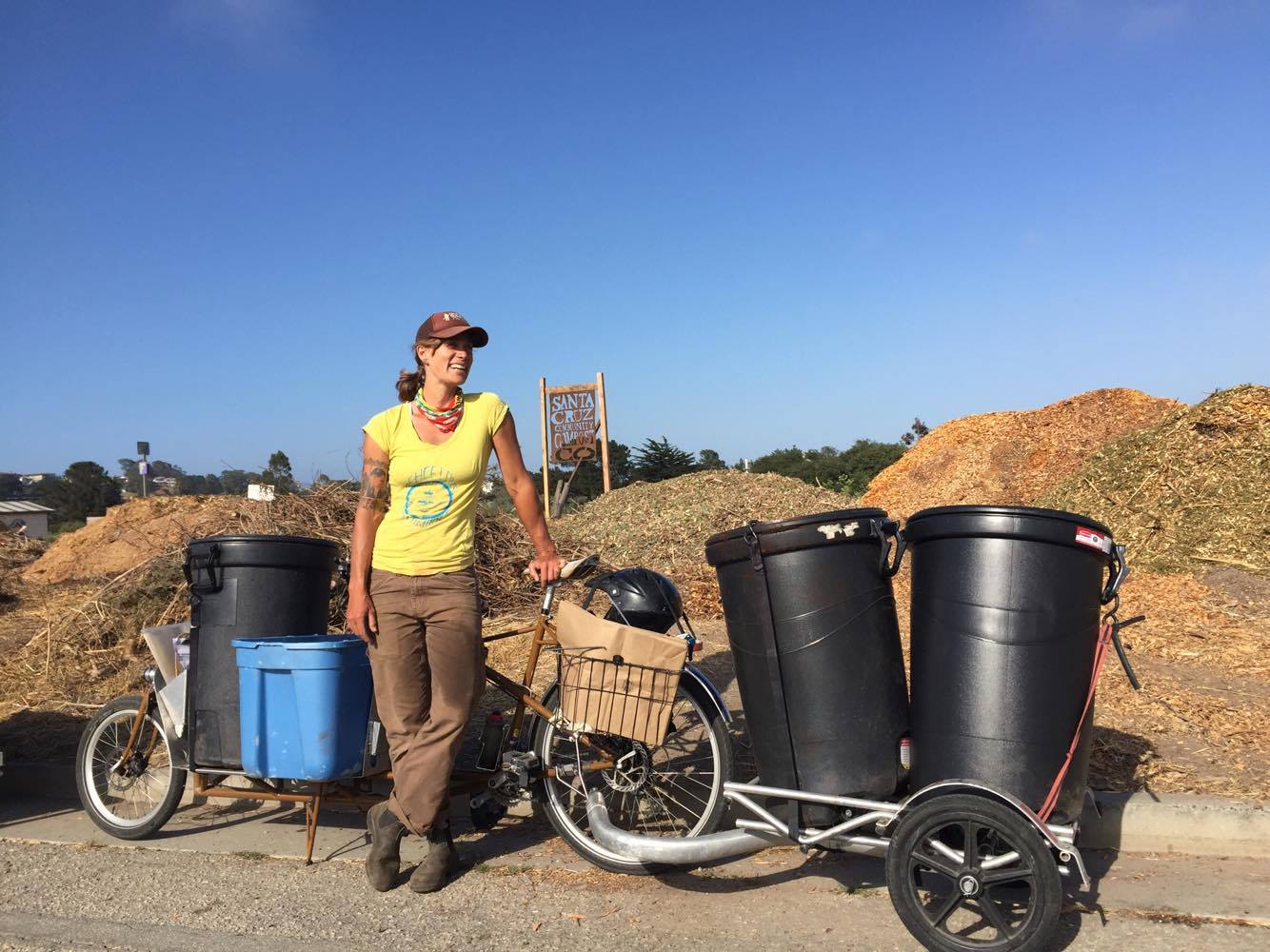
November 2016 Sustainability Profile: Ivy Young of Santa Cruz Community Compost Co.

Each month, our newsletter features a person or group that is working toward a more sustainable world. This month we are featuring Ivy Young of Santa Cruz Community Compost Co., which employs a number of UCSC alumni and turns Santa Cruz residents' food scraps into rich compost.

big haul.jpg
What does your organization do?
Santa Cruz Community Compost Co. is a bicycle-powered, community oriented, compost collection service. Customers collect their food scraps and other compostables in the bin we provide. Then, we pick it up weekly via cargo bike and deliver it to a local urban farm where we transform it into high quality fertile soil that is either returned to our customers or made available to the host farm.

How many pounds of food scraps does your organization divert from the landfill each year in creating compost? How many miles do your riders bike compost each year?
Since our first haul in June 2014 we have diverted more than 130,000 lbs of waste from the local landfill and we’re hauling around 2000 lbs more every week from around 250 local homes and businesses. Though we don’t track our riders’ miles, we cover ground from Shaffer at Delaware all the way to 42nd Ave and even take a trip up to the UCSC faculty housing once a week.  

How did you decide to use bicycles for transporting the compost?
The idea was originally sparked by a company in Austin, TX, the Compost Pedallers, that operates using a similar model. While bicycle transport does present some challenges, we believe in operating our business in a way that is energy efficient, inspiring and honors our core values. Bicycles are clean, quiet and when people see us out riding it puts a smile on their face.  

What’s one of your favorite memories associated with your organization and composting?  
I’m a single mom and in the first 6 months of operating routes, I often had my then 5 year old son riding on the back of my bike with me as I trekked all over town.  He would keep me company by singing “Keep on the Sunny Side” and he would chant “go mama, go mama, go” whenever I had to go up a hill.  I feel so grateful that he has been able to share in this experience and see what is possible when you work hard for something you believe in.

How did you get involved with composting?
I grew up composting so I’m someone who feels very strange whenever I’m faced with throwing a banana peel in the trash.  Most of my previous knowledge, however, was in the realm of small, backyard piles.  I have had to learn as I go about how to handle such large amounts of organic waste and I still have a lot more to learn.  I have become so excited now about the microbial universe living within a compost pile and the incredibly transformative process that occurs there that the work I’m doing is becoming a sort of philosophy to me.  

What does “sustainability” mean to you?
I don’t think that “sustainable” is just a catch phrase for the green movement.  To sustain something is to find the balance between what is possible and what is plausible. Sustainability is getting out on your tiptoes, reaching out for your most perfect Ideal, but not letting your feet leave the ground because you can’t inspire others when you’re floating in a bubble way out of reach, and it’s our collective efforts that will really make a difference. Sustainability to me is waking up each day, doing the very best you can and believing that your neighbor is doing the same.  

Has this job influenced you to live more sustainably in other ways?  
This work pushes me to my limits sometimes physically, socially and emotionally and while I had always considered my lifestyle to be sustainable because I eat organic, compost, and reuse my plastic bags and twistie ties at the bulk bins, I had never considered whether my inner life, social life or physical existence were truly sustainable. I’ve really tried in the last few years to apply the spirit of sustainable living to more than just how I consume things. Now, I ask myself questions like, “Am I an energy efficient vehicle?” “How does the energy I expend contribute positively to my community?” “Where is my time/energy/spirit being wasted and where is it being transformed into something useful?” I see the transformation that occurs in my piles--rotting detritus that smells somewhat like baby vomit becoming fresh living healthy soil that smells like the rain forest--and it gives me hope that even the most rotten things in life can, with time, be transformed into something beautiful.

Thank you, Ivy Young, for sharing about your work and inspiring us! To learn more about Santa Cruz Compost Co., visit their website.

NOLS Internship Details

NOLS INTERNSHIP

INTERNSHIP TITLE:  NOLS Sustainability Intern

SUPERVISOR TITLE:  NOLS Sustainability Coordinator

INTERNSHIP LOCATION:  NOLS World Headquarters, Lander, Wyoming.

DATES OF INTERNSHIP:  January-May 2017 (start and end dates are flexible)

INTERNSHIP OBJECTIVE:  The NOLS sustainability intern will assist the environmental stewardship & sustainability director and sustainability coordinator with a variety of tasks related to sustainability initiatives at NOLS, community outreach, and public policy.

INTERN QUALIFICATIONS:  High school diploma. Current college students and recent graduates preferred, majoring in a related field. Familiarity with NOLS is a plus. Applicants are encouraged, but not required, to have prior experience with sustainability concepts and Microsoft Excel. On the job training will be available as needed.

PROFESSIONAL/EDUCATIONAL OPPORTUNITIES:  The sustainability intern will have opportunities to work with other departments and participate in educational activities, including:
  • Participate in a course issue day(s).
  • Develop content for the blog and social media with guidance from the NOLS marketing and creative departments.
  • Coordinate a community event.
  • Attend the NOLS Faculty Summit.
  • Participate in a NOLS seminar, space allowing.
  • College credit may be available.
  • Interns should not expect a paid position at the conclusion of the internship.

TIME COMMITMENT:  20 hours/week

STIPEND:  A bi-weekly (every two weeks) stipend of $125 is provided to help defray expenses incurred during the internship.

RESPONSIBILITIES:  Projects may include the following:
  • (40%) Manage carbon data.
  • (20%) Work with various NOLS campuses to research sustainability opportunities specific to that location (i.e. alternative fuels, farming, renewable energy, etc.).
  • (15%) Organize an Earth Day outreach event.
  • (10%) Create engaging outreach material for NOLS sustainability.
  • (10%) Participate in broader NOLS activities.
  • (5%) Perform administrative tasks as needed.

CRIMINAL BACKGROUND CHECK:  A criminal background check is required.

E-VERIFY:  NOLS participates in E-Verify.

HOW TO APPLY:  Send cover letter and resume to:
NOLS Sustainability Coordinator - Kara Colovich   

CLOSING DATE FOR APPLICATIONS:  November 4, 2016

Thank you for your interest in NOLS. Please consider providing some optional, anonymous information by completing this survey.

Kara Colovich
Sustainability Coordinator
NOLS

Friday, October 21, 2016

November 2016: Contests and Funding

Carbon Fund: Deadline November 7
The UCSC Carbon Fund is currently accepting applications for the 2016-17 funding cycle until 11:59 PM on Monday, November 7. This student fee granting body funds student, staff, faculty, and community projects that reduce our carbon footprint, conduct relevant research, or carry out educational programs. Learn more and apply on the website.

Giving Day: Early deadline November 3
Do you have a project that needs funding? On March 8, 2017, the campus will play its second annual Giving Day game. Giving Day is a 24-hour online fundraising drive to support UC Santa Cruz students, faculty, and campus programs. In 2016 UCSC held our first Giving Day and it was a huge success. We raised $339,276 in just 24 hours, benefitting 60 UC Santa Cruz programs. The sooner you sign up, the greater your chances to connect with a donor who might be willing to support your project with matching funds. You’ll also have a chance to win $100 in our early-entry raffle. The deadline for the raffle is November 3rd. Sign up today to play the Giving Day game and get your project funded.

SeedMoney: Deadline November 12
SeedMoney is a Maine-based 501c3 nonprofit that is helping public food gardens around the country to start and thrive by offering them grants, access to crowdfunding and technical assistance with garden planning. Their mission is to help more people, especially disadvantaged populations, to grow and access more of their own healthy food. They do this through crowdgranting, a new way for nonprofit causes to access funds for their work. It combines crowdfunding with challenge grants. In the case of SeedMoney, participating projects use the possibility of securing a challenge grant of $400 from them to motivate local donors in their area to contribute to their project. Find out more on their website and apply by November 12.

Big Ideas: Deadline November 16
Big Ideas, one of the nation’s oldest and most prestigious social impact contests, is accepting pre-proposals for this year’s competition. Big Ideas provides up to $300,000 directly to students each year for their groundbreaking initiatives. Armed with the training and seed funding provided by Big Ideas, student teams have gone on to secure over $150 million in additional funding for their for-profit, nonprofit, or hybrid ventures. Learn more here.

Monday, October 3, 2016

Presenting Supplier Sustainability at the California Higher Education Sustainability Conference

by Will Watson

Last year I participated in the Provost’s Sustainability Internship (PSI) program. My internship was with Procurement Services and built off of the previous intern’s project. Procurement Services purchases everything for our campus from paper to soap, to million dollar microscopes, to determining what large soda provider gets contracted with our campus.

The companies that provide our campus with goods and services are called suppliers. The intern before me worked to benchmark 10 of UCSC supplier’s operations pertaining to sustainability, such as “Does your company have an Environmental Protection Policy?” or “Does your company occupy any LEED certified buildings?” My project started as an expansion of the previous interns work, but evolved into something entirely new.

My mentor and I started communicating with a local consulting firm, EcoShift Development, about utilizing their cloud based supply chain platform, SupplyShift, for the extension of our project. UC San Diego used SupplyShift for a life science supply chain benchmarking project in 2014. Further, UCSC’s SupplyShift pilot looked at how a cloud based benchmarking platform could connect Procurement Departments, aggregate purchasing power, and influence our suppliers operations. UCSC modified UC San Diego’s scorecard, supplier survey, and aimed to benchmark suppliers from each category: Life Sciences, Information Technology Services, and Maintenance, Repairs, and Operations.

The project targeted 46 suppliers with a 63 percent response rate. This is just the tip of iceberg for UCSC’s supply chain though, which includes over 10,000 annual suppliers. The project results were presented in coordination with UCSD at the California Higher Education Sustainability Conference, spreading awareness and the potential for benchmarking supply chains.


The project is continuing this year, with a myriad of options and areas to expand. If the waste, carbon footprint, social equity, or other problems associated with purchasing mass quantities of goods for UCSC concerns you or interests you, read project updates on Project Clearinghouse or contact the Sustainability Office at sustain.education[at]ucsc[dot]edu to get involved.

Friday, September 30, 2016

UCSC Recognized for Higher Ed Sustainability Achievements

If there were a class in sustainability higher education, UCSC would be getting an A+. In the last few months, UC Santa Cruz received recognition from three institutions that rate universities and colleges for their higher education sustainability efforts.

In June, we earned a gold rating from the Association for the Advancement of Sustainability in Higher Education (AASHE) Sustainability Tracking and Rating System (STARS)--up from a silver rating in 2015--for our commitment to sustainability. STARS is designed by AASHE to be a transparent, self-reporting framework for colleges and universities to measure their sustainability performance. Learn more about our Gold STARS rating here.


Then, just last month, the Sierra Club's Sierra magazine released its 10th annual “Cool Schools” ranking of America’s greenest colleges and universities. More than 200 schools participated in Sierra’s extensive survey about sustainability practices on their campus, and UC Santa Cruz is one of three UCs to be in the top 20! Coming in at #18, the ranking underscored UC Santa Cruz’s strong commitment to protecting the environment, addressing climate change, and encouraging sustainability. Read why Sierra says we're #18 in the nation here.

Finally, we are also on the Princeton Review's Green Colleges Honor Roll again this year, coming in at #32. The listing cites UC Santa Cruz for cutting greenhouse gas emissions, ‘greening’ design and construction projects on campus, and integrating sustainability at every level. Read the full story here.

Thursday, September 29, 2016

Metro Service to Safeway

The Route 20 Metro bus (UCSC via Westside) now serves the Almar Shopping Center, which includes Safeway, Panda Ex-press, Ace Hardware, Almar Cleaners, Great Clips, a UPS store, and the Westside Coffee Company. Five weekday trips starting at 6:15pm and five weekend trips starting at 4:20pm will serve these businesses, located on Mission Street at Almar Avenue. Look for Route 20 schedule information herehttp://scmtd.com.