Pages

Connect With Us!

Tuesday, February 17, 2015

March 2015: Contests & Funding

Contribute your art to Everybody's Ocean: Deadline April 26
Right now, there are 158 pieces of art in the 2nd Floor Solari Gallery. Every piece is about the ocean. They're from all kinds of people around Santa Cruz. And we want more of it. You’re invited to submit work that depicts the ocean or represents whatever it means to you. This exhibition explores our relationship with the sea. There will be a diverse set of work by local artists, regional artists, and you. Email curator[at]santacruzmah[dot]org to have your art in the show. Click here for details about how to submit.

International Film Festival: Deadline May 4
The International Film Festival for Environment, Health and Culture is accepting submissions for films pertaining to environment, health and culture issues. There are five submission categories: international feature film, international short film, documentary feature, documentary short and newcomer. The film festival will be held on May 27.


Call for Applications: Awards in Solar Energy Research: Deadline May 7
The U.S. Department of Energy's Energy Efficiency and Renewable Energy (EERE) Postdoctoral Research Awards support EERE's mission in energy efficiency and renewable energy by offering recent Ph.D. recipients the opportunity to conduct applied research at universities. The objective of the awards is to support scientific research in energy efficiency and renewable energy by attracting the best scientists and engineers to pursue breakthrough technologies in a highly prestigious postdoctoral research program. Deadline to apply is May 7.


Biomimicry Global Design Challenge: Deadline August 3
The Biomimicry Institute and the Ray C. Anderson Foundation announced the opening of the Biomimicry Global Design Challenge. Students are invited to submit commercially viable, nature-inspired solutions to global food system challenges. All participants get access to the Design Challenge Toolbox and supporting resources, including sessions with mentors and biomimicry professionals. The grand prize, to be awarded in 2016, is $100,000. The deadline for submissions is August 3rd.

Energy Dept $2.5M for Collegiate Clean Energy Tech: Deadline June 7
The newly announced $2.5 million in funding for the Cleantech University Prize (Cleantech UP) aims to support the commercialization of promising technologies for sectors such as solar and wind that reduce carbon pollution and grow the clean energy economy. The Cleantech UP Collegiate Competitions will provide prizes for eight individual university-focused competitions that will equip students with business skills to move clean energy technologies from the discovery phase to the marketplace.

March 2015: Classes, Training, and Community


College 8 Garden Hours
College Eight provides a 1-unit class at the garden every quarter, in which student learn about soil, composting, food systems, and much more. The garden promotes sustainable agriculture and student involvement with the community. Situated by the College Eight dining hall, the garden provides a beautiful space for learning. Anyone is welcome to help with the garden during working hours! Please email the campaign coordinators Lisa Hall, lirhall [at] ucsc [dot] edu or Katrina Carr, kocarr [at] ucsc [dot] edu with any questions.

Earth Summit - Table or Lead a Workshop: April 24
The 14th annual Earth Summit will be an all day event celebrating sustainability on campus and in our community. Throughout the day there will be fresh local foods, informative and fun workshops, tabling, keynote speakers, student art, entertainment, and much more!  If you are interested in leading a workshop, contact Tatiana Gefter at tgefter [at] ucsc [dot] edu.  If you are interested in tabling, contact Lucia Calderon at lecalder [at] ucsc [dot] edu.


CA Farm to School Conference: May 4-6
Are you interest in the food that is in your dining halls and who it is provided by? Conference Theme: Connecting. Growing. Leading. "The California Farm to School Conference will offer a series of workshops, panels and discussions that will be of significant educational and networking value to attendees who will represent all facets of the farm to school movement, including farmers, distributors, government representatives, procurement officers, educators, and food program administrators." It will be taking place at Asilomar in Pacific Grove, CA from May 4th - 6th. If you want any further information on this conference please click here to access the website.

Education for Sustainable Living Program Spring Classes
Are you interested in social justice, food systems, renewable energy or any other Blueprint for a Sustainable Campus topics? Take the ESLP class for 2 or 5 units next quarter! Designed and led by undergraduate students. Go to eslp.enviroslug.org to learn more about class offerings and how to enroll.


Agroecology, A Global Movement: Tracing Our Roots and Looking Forward
The 16th Annual Agroecology Shortcourse will explore the roots of agroecology as a global movement as well as a science and a practice from July 12-25, 2015. Santa Cruz offers the ideal context to examine historical and current issues of social and environmental equity and sustainability that agroecology movements confront all over the world. The course aims to introduce agroecology and strategically connect the diverse and powerful agroecology experiences and movements active worldwide and create a collective overarching view of the current global situation. The course will end with a vision of how to better facilitate cross-fertilization across agroecology movements and overcome obstacles to convergence. For more information, contact can.shortcourse [at] gmail [dot] com or visit the website.

This is heating up fast.

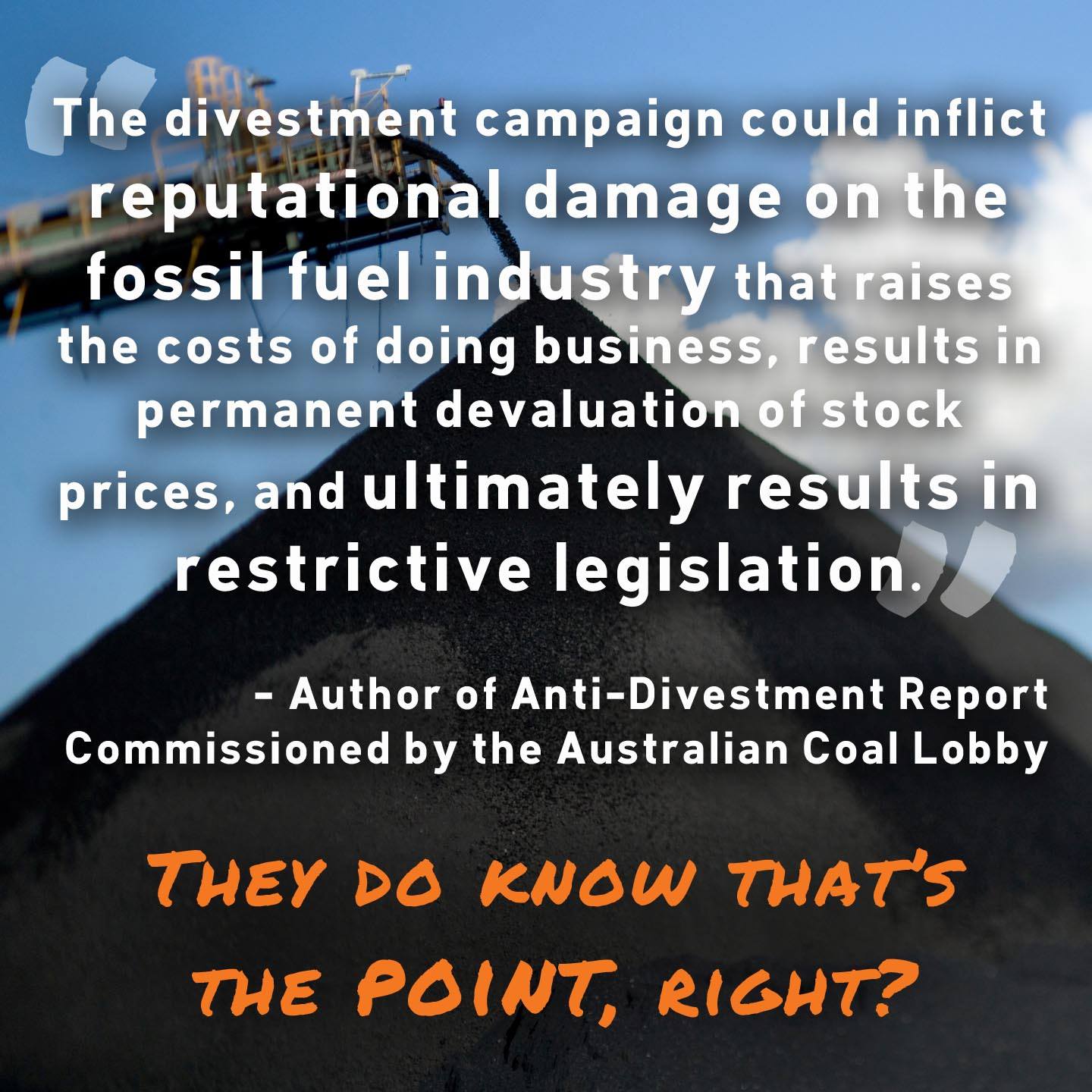
I'm not talking about climate change (directly). I’m talking about the debate around divestment from fossil fuels at universities and institutions around the world. Friday (2/13) was the first ever Global Divestment Day, calling on “climate leaders” to dump fossil fuels from their investments. I can’t sum up why divestment matters better than this Mean Girls-themed BuzzFeed article, or this prescient quote from the Australian coal lobby:

10403975_10152472894182708_2508739122957633330_o.jpg


And the industry is noticing. Last week alone, there have been studies and articles and videos “debunking” divestment (funded by the Independent Petroleum Association of America, along with other pressure groups), while completely missing the real point of divestment: we aren’t trying to affect the stock price of BP, but divestment does go a long way towards delegitimizing and revoking the fossil fuel industry’s social license to operate. Just listen to Archbishop Desmond Tutu, a leader in the Anti-Apartheid movement who knows a thing or two about making change:


At the University of California Santa Cruz, Fossil Free UC has been campaigning for years to get the university to ditch $3 billion dollars worth of fossil fuel investments and put the money into climate solutions. Chancellor Blumenthal wrote this blog post on our efforts to coincide with the GDD festivities!


And in celebration of the corrupt corporate relationships of our time, the University of California renewed their vows to the fossil fuel industry at a mock wedding in the College 8 Plaza. Video to come!


Monday, February 9, 2015

#POCsustainability's First Round Table Discussion

#POCsustainability is an awareness campaign through UCSC's Ethnic Resource Center that aims to showcase the contributions that people of color have made to the environmental movement. 

The #POCsustainability campaign will be hosting it's first world cafe style discussion on Wednesday, March 4th from 4-5:45pm in the Amah Mustun Conference Room. They are inviting students to join to discuss sustainability practices of their cultures and to have a critical dialogue about the current state of the campus environmental movement.

This is a great opportunity to learn how social and environmental justice are truly related through first-hand experiences.  It is also a place to share your personal experiences in a collaborative space.

Disappearance of Pikas Due to Climate Change

If you've been hiking around California's mountains, you might have noticed these furry little, bunny-like critters scurrying around.  Joseph Stewart, a graduate student at UCSC, says populations of pikas were most likely to go locally extinct at sites with high summer temperatures and low habitat area.  About 15% of researchers surveyed 67 locations with historical records of pikas and found that the animals have disappeared from ten of them.


These little animals are well-adapted to cold temperatures and high-elevations but these adaptions make them even more vulnerable to global warming.  Pikas play a big ecological role because they are prey to many species, such as owls and stoats, and they alter vegetation and soil composition through their foraging activities. 

University News reports, "If only modest action is taken to reign in greenhouse gas emissions, the model predicts that pikas will disappear from about 75 percent of sites by 2070 (51 to 88 percent, depending on the global climate model used). With aggressive action to reduce greenhouse gases, the model predicts that only about 51 percent of sites will suffer local extinction (39 to 79 percent, depending on the global climate model)." 

The disappearance of pikas is just another reflection of the reality of climate change and the ecological consequences of their extinction can easily alter other species and habitats.  As Banksy, a political graffiti artist, has said in one of his Twitter posts: "It's not just one tree that falls".  Every little part of our ecosystem affects the whole environment.


UCSC's Economics Department, Social Justice and Sustainability

University News reports, "Rob Fairlie, chair of the Economics Department at UC Santa Cruz, has been commended by the state legislature for service to California through his work to reduce poverty and inequality, improve education and human capital, and increase job opportunities and entrepreneurship."


Rob Fairlie has been contributing to the socio-economic movement through his involvement with projects on entrepreneurship and small business training, and providing access to technology for students in middle school through community college.

He has also been involved with research studies that look at whether providing improved access to computers could help low-income students on financial aid perform better and whether underrepresented minority students perform better when taught by underrepresented minority instructors.

You might be wondering how social justice is related to sustainability, but the fact of the matter is that both thrives off of each other.  If we want to see a world that is environmentally sustainable, we need a society that is economically and socially sustainable.  This means that to fight any type of environmental injustice, social change is also necessary so that we can all move forward together and fight the social injustices that prevent our solidarity.  This idea is represented in an article relating the #BlackLivesMatter and climate change campagins:

"Thinly veiled notions of racial superiority have informed every aspect of the non-response to climate change so far. Racism is what has made it possible to systematically look away from the climate threat for more than two decades. It is also what has allowed the worst health impacts of digging up, processing and burning fossil fuels—from cancer clusters to asthma—to be systematically dumped on indigenous communities and on the neighborhoods where people of colour live, work and play."

Wednesday, February 4, 2015

Green Labs Program Presents Energy-Efficient Equipment Funding!

Greetings from the Green Labs Team, and happy 2015!! At UCSC, labs contribute over 50% of energy consumption, and produce over 12% waste to landfills. Here at Green Labs, we seek to improve energy efficiency, increase green purchasing and reduce waste through behavior change, physical improvements, and education. This year, the Green Labs student committee has made great progress towards a more sustainable UCSC!

We are excited to announce the implementation of a “Green Labs Equipment Fund”, made possible through a Carbon Fund macro-grant. This will be available to all labs on campus that have been certified through the Green Labs program, and will be a source for energy-efficient equipment retrofits of common lab equipment like freezers, centrifuges, and incubators. Aside from energy savings and greenhouse gas reductions, this project will contribute energy use data for labs, and other institutions will be able to reference this data in weighing the costs and energy savings of implementing retrofits in their own labs.

In the coming months, the team will be outreaching around campus, certifying labs, and compiling a list of recommended energy-efficient equipment. With increased involvement from the lab community, UC Santa Cruz will be one step closer to reaching the UCOP goal of carbon neutrality by 2025.


If you have any questions or inquiries,
please contact greenlabs-group[at]ucsc[dot]edu,
and visit our website to learn more about the program.

  -- Lily Urmann and the Green Labs Team


Chrissy Thomure (Climate Action Manager), Lily Urmann (Green Labs Facilitator), Robert Jones (Carbon Fund Student Facilitator), Jaric Sawatdee (Green Labs Outreach Coordinator), Ariel Lee (Carbon Fund Outreach Coordinator), Alden Phinney (Climate Action CUIP)

Spelling out "CLIMATE" at the Sustainability Office Retreat