Pages

Connect With Us!

Showing posts with label solar. Show all posts

Thursday, December 1, 2016

December 2016: Classes, Trainings & Community

UCSC Farm Produce Pop-up Thursdays from 10 am - 3 pm
Come and enjoy the UCSC Farm Produce Pop-up on Thursdays from 10am to 3pm at the Quarry Plaza! Food Systems Working Group will have a variety of vegetables and flowers from the UCSC CASFS Farm and select fruit from the Downtown Farmer's Market. They are now accepting EBT/CalFresh! The purpose of the pop-up is to bring the farmers' market to UCSC for students and to increase access to healthy and affordable food for all. If you have any questions, please contact Food Systems Working Group or visit their Facebook page.


UC Natural Reserve System Field Studies Summer Program, California Ecology and Conservation Summer Program: Deadline February 3
The UC Natural Reserve System is now accepting applications for the Summer 2017 Field Studies Program: California Ecology and Conservation. Applications are due on February 3rd. Students from across the UC system have gained strong independent scientific research skills while immersed in the training grounds of the UC natural reserves, from Big Sur to the Mojave Desert, from coastal redwoods to California grasslands to high altitude bristlecone pines. Check out this video and the article Non-stop Nature to get glimpses of what students are calling the most rewarding experience in their undergraduate careers. 

Santa Cruz New Tech Meetup: December 7 at 6 pm
Join the Santa Cruz New Tech Meetup community at Cruzio & Ecology Action Green Building in downtown Santa Cruz (877 Cedar Street). Learn about hot new technologies and mingle with 250+ fellow entrepreneurs, investors, bloggers, and tech enthusiasts. This event is always packed, so be sure to RSVP early. Doors open at 6:00pm, presentations start at 7:00pm. Entry fee is $10, and $5 for students with valid ID (pay at the door), and includes food, beverage, and live music.

Sun-Work Rooftop Solar Energy Training: December 10 & 17
A free 3-hour training session about rooftop solar energy will be offered on Saturday, December 10 from 9 am to 12 pm in San Jose and Saturday December 17 from 2-5 pm in Berkeley.  They're being sponsored by SunWork, a Bay-Area nonprofit that installs rooftop PV systems on small-energy-footprint homes with the help of volunteers. Register for the training online.

Santa Cruz Permaculture Design Course: January 1 Early Bird Deadline
Permaculture is an ethically based whole-systems design approach that uses concepts, principles, and methods derived from ecosystems, indigenous peoples, and other time-tested systems to create human settlements and institutions. This course includes the internationally recognized 72-hour curriculum, augmented by an additional 38-hours of hands on practice and field trips. Plus, folks have the option to camp on site each weekend, and build community around the fire! The early bird deadline is January 1st and there are payment plans, low-income and youth POC discounts for the course as well. For more information or to sign up, visit their website.


School for Field Studies Environmentally Focused Study Abroad Opportunities
SFS creates transformative study abroad experiences through field-based learning and research. Their educational programs explore the human and ecological dimensions of the complex environmental problems faced by local partners, contributing to sustainable solutions in the places where we live and work. The SFS community is part of a growing network of individuals and institutions committed to environmental stewardship. Learn more about UCSC opportunities through this program here or visit the website.

Free workshops & trainings with Post-Landfill Action Network
The Post-Landfill Action Network (PLAN) cultivates and educates the student-led zero waste movement and informs students about the waste crisis, equipping them with the necessary skills and resources to implement solutions about waste into their campus communities. UC Santa Cruz is a PLAN member school, which gives us free access to resources and support from PLAN, including workshops and trainings focused on student leadership and how to effectively reach zero waste. Learn more about these opportunities on the blog.

Rangel International Affairs Summer Enrichment Program: Deadline February 2 
This is a six-week program at Howard University that helps prepare undergraduate students for careers in international affairs. It includes two for-credit academic courses, a professional writing seminar, visits and meetings with foreign affairs professionals in a wide range of government and non-governmental organizations, and professional development activities. The program will run from mid-June until late July and encourages the application of members of minority groups historically underrepresented in the Foreign Service and those with financial need. Applicants with any undergraduate major are welcome to apply. Additional qualifications and information about how to apply are on their website.

Friday, January 22, 2016

Sustainability Minor in Full Swing

Written by Kelsee Hurschman, with contributions by Christine Ongjoco

Opportunities for UCSC students to pursue sustainability education and research are growing! The College Eight Sustainable Studies pilot minor is now in full swing. Sustainability Studies was officially launched in 2014 and provides students with hands-on, interdisciplinary educational experiences -- teaching students applied skills and knowledge through a focus on real-world problem solving.

Students enrolled in the minor have the freedom to choose between a broad range of upper division courses offered by several different departments including anthropology, economics, sociology, and legal studies. The minor can be completed easily in two years; see the website for more information about requirements and how to enroll.

Angela Duong, a student in the Sustainability minor, believes that "sustainability is such a 'new age' field and it's super cool that UCSC has a minor for it! [It] is important to learn and practice in our everyday lives and will help improve our future."

Another student, Kelsee Hurshman, says "... learning about living sustainably is important because all of our resources come from the earth and we need to change our habits so that we can live in harmony with the planet. Being in these classes sheds light on problem-solving instead on dwelling on the horrible state of the planet other classes do, giving a feeling of hopelessness."

In the minor, the Sustainability Practicum allows students to work in research groups to develop policy solutions for sustainability problems and fieldwork projects that build analytical and applied skills.

Some students like Jamison Czarneck transferred to UCSC exactly for the Sustainability minor because of the hands-on experience in the program. He was involved with a project that did a LEED analysis of a building in downtown Santa Cruz and looked at the predicted energy usage versus the actual energy usage of the building with 2 years of data.
So far, it has been a positive and rewarding impact on my studies and my perception on the challenges around achieving sustainability. I am looking into sustainability management as a career so the minor seemed to make a lot of sense. So far I've learned about service learning, life cycle analysis of products, energy efficiency strategies, social behavior of sustainability problems, analytical tools and policy influences, and a lot more.  - Jamison Czarneck
This year, other students are working on three projects: an Urban Agriculture protocol, “Ecotopia House”, and a Renewable Energy Microgrid.


The Urban Agriculture Research Project is working to obtain quantifiable data by developing small-scale, long-term planting beds in College Eight Garden and PICA.  Students have developed a system to measure all of the inputs and end products of the garden. Analyzing this, students will find the best practices for urban agriculture – to create a maximum output of crops with little labor in the garden and money spent.

A student part of the Urban Agriculture Research Projects, gave us an update on the project:
Last quarter we set up galvanized beds and felt pots in the College Eight Garden. We planted lettuce, spinach, kale, garlic, snap peas, beets, and onions. We will be harvesting some produce soon and recording the pounds of produce as well as the amount of calories of food harvested. Who thought I could be doing research as I garden and produce food to eat? - Kelsee Hurshman

Ecotopia House is a collaboration between College Eight and Cabrillo Community College as part of a collegiate competition sponsored by the Sacramento Municipal Utility District. The completed Ecotopia House will be a small living space with a smaller carbon footprint directed toward affordable and resource-efficient housing, especially for urban areas. Students are analyzing various household features to include the most energy efficiency, cost-effective attributes.

The Renewable Energy Microgrid project involves behavioral analysis and technical monitoring of energy and water consumption at a cohousing development in Santa Cruz county. Fieldwork includes behavioral surveys and interviews focused on residents energy attitudes and practices; high resolution, real-time monitoring of electric energy use (with more funding, gas energy and water use as well) at a plug load, circuit load, and meter load level; and design, deployment (subject to the outcome of emerging electric energy policy), and monitoring of an advanced neighborhood microgrid.

Students can also do the IDEASS program as an elective for the minor. IDEASS participants work with researchers and professionals to plan, design, and then implement a selection of projects that use cutting-edge technologies in the development of sustainable systems. In 2016, there are five IDEASS projects: Clean Oceans International, Smart Irrigation, Tiny House, Smart Energy, Solar Lanterns, DROPS, and Porter Purple Pipes.

IDEASS students are partnering with Clean Oceans International, a nonprofit using Captain Homer’s plastics-to-fuel (P2F) conversion machine, to explore the costs and benefits of using this technology to clean up the vast amounts of plastics accumulating in our biosphere and threatening marine ecology. The new P2F conversion machine is expected to recycle about ten pounds of plastic into a gallon of clean fuel per hour. Students at UCSC are working with the non-profit to analyze the machine’s energy efficiency and characterize pollutants and other byproducts of the conversion process.

The Smart Irrigation II project is expanding on the software design and electrical system components delivered by a team of engineering students in spring of 2014-2015. This project will demonstrate how sensor network will use real-time data to calibrate the release of capture rainwater with changes in soil moisture. The improved system will not only use moisture sensors to offer autonomous irrigation control but will integrate sensors to monitor temperature, pH, phosphorous, potassium, salt, and nitrogen concentration. Accommodations for off-grid solar power and energy storage make this system truly avant garde. The irrigation system will be installed on campus at Center for Agroecology and Sustainable Food Systems (CASFS) and College Eight garden after initial installation at Natural Bridges High School.


Students are working to create industry standards for the manufacture and distribution of off-grid Solar Lanterns to replace kerosene lanterns used across the Global South, especially Africa. Although international organizations including Solar Aid and the World Trade Organization, promote this off-grid alternative, the Silicon Valley Toxics Coalition has determined that the short life span of these products and lack of proper waste management is unsustainable. Old or broken lanterns are usually incinerated with other refuse in communities that lack the resources, knowledge or infrastructure to repair or recycle components. Students involved During 2016, IDEASS Solar Lantern students are working to disassemble and re-engineer the lanterns in order to develop guidelines for a more sustainable prototype.

DROPS students are reducing negative water quality impacts on Neary Lagoon, and Bayview Elementary School by using rainwater catchment, bioswales, and rain gardens to recycle greywater for lawn and garden irrigation. Bayview Elementary School has a Life Lab Program that will integrate water conservation into the curriculum and teach students about how water travels across the watershed and how to test water quality in nearby watersheds.

Bayview Elementary’s lawn (left) Lifelab classroom vegetable beds (right)

Graphene is a potential material that could replace silicon as a semiconductor. Smart Energy (also see this website) students are determining the best methods of Graphene production in terms of cost, environmental impact, and scalability. They are composing a list of methods to maximize the effectiveness of graphene as a substrate supercapacitor with the smallest impacts to the environment.


IDEASS students working on the Porter Purple Pipes Project are collaborating with engineers, planners, and plumbers to participate in the process of planning, designing, and constructing a graywater recycling system for flushing toilets in Porter dorms.


With the Sustainability Studies minor now in full swing, we can't wait to see what future student-led projects will accomplish!

Sunday, November 1, 2015

The Arboretum is partnering with Allterra Solar

The Arboretum is partnering with Allterra Solar to increase awareness about the Arboretum and the benefits of switching to solar and the urgency for doing it now. Tax credits are going away in 2016 plus the price for selling energy back to PG&E is decreasing next year, but if you sign up for solar soon you will be locked in to the higher rate of return for 20 years! There's great information on the urgency and current incentives here.

Allterra Solar will give every eligible person (must own house) a gift family membership (worth $65) to everyone who signs up with the promo code of "ARBOR" by the end of the calendar year. If someone is already a member, they can regift it.

Additionally, for everyone who goes solar, Allterra will donate $500 to the Arboretum.

This is a great example of private/public partnership, great town/gown relations, and community support.

Thursday, October 1, 2015

City of Santa Cruz & UC Santa Cruz Install Solar Streetlamp Research Pilot at Wharf

As part of the award-winning GreenWharf partnership, the City of Santa Cruz and UC Santa Cruz have installed an innovative solar streetlamp at the end of the Wharf as a research pilot project.

Provided by Mira Bella Energy of Peoria, Arizona, the solar streetlamp mirrors the gooseneck style of the existing streetlamps at the Wharf, which were upgraded to LED technology over the past two years. This design is intended to outperform other conventional panel technologies through a bifacial solar cell capturing scattered light on both sides of the cell array, even in overcast sunlight conditions. The vertically oriented panel design also reduces the potential for seagull excrement fouling which has limited the effectiveness of previously installed solar technologies at the Wharf. The solar streetlamp is outfitted with a battery pack inside the lamp pole, yet is also tied to the electrical grid for backup to the solar-battery system. The solar streetlamp’s performance will be monitored and timing and intensity can be adjusted via an online dashboard. Research will focus on the impact of an overwater installation on energy production and performance in a harsh marine environment.

“In addition to the vertical axis wind turbine in operation since 2011, the solar streetlamp is an innovative technology being piloted at the Wharf. Its real-time, web-based performance monitoring creates many research opportunities for students and faculty” said Dr. Michael Isaacson, Director of UCSC’s Center for Sustainable Energy Power Systems and principal investigator on the project.

It is a goal of the project to provide the public and other researchers access to the solar streetlamp’s performance data. UCSC researchers currently collect data on wind speed, solar irradiance and energy generation from the wind turbine and solar panel at the Wharf Headquarters. Access to the data sets and more information on the GreenWharf partnership is at www.greenwharf.org.

Wharf Supervisor Jon Bombaci adds “The solar streetlamp research pilot is another successful public-private project launched through the City-UCSC partnership, providing valuable research opportunities, educational experiences and helping to make the Wharf green.”

For more information on the GreenWharf partnership, please contact Ross Clark at (831) 420-5113 or rclark [at] cityofsantacruz [dot] com.

Tuesday, February 17, 2015

March 2015: Contests & Funding

Contribute your art to Everybody's Ocean: Deadline April 26
Right now, there are 158 pieces of art in the 2nd Floor Solari Gallery. Every piece is about the ocean. They're from all kinds of people around Santa Cruz. And we want more of it. You’re invited to submit work that depicts the ocean or represents whatever it means to you. This exhibition explores our relationship with the sea. There will be a diverse set of work by local artists, regional artists, and you. Email curator[at]santacruzmah[dot]org to have your art in the show. Click here for details about how to submit.

International Film Festival: Deadline May 4
The International Film Festival for Environment, Health and Culture is accepting submissions for films pertaining to environment, health and culture issues. There are five submission categories: international feature film, international short film, documentary feature, documentary short and newcomer. The film festival will be held on May 27.


Call for Applications: Awards in Solar Energy Research: Deadline May 7
The U.S. Department of Energy's Energy Efficiency and Renewable Energy (EERE) Postdoctoral Research Awards support EERE's mission in energy efficiency and renewable energy by offering recent Ph.D. recipients the opportunity to conduct applied research at universities. The objective of the awards is to support scientific research in energy efficiency and renewable energy by attracting the best scientists and engineers to pursue breakthrough technologies in a highly prestigious postdoctoral research program. Deadline to apply is May 7.


Biomimicry Global Design Challenge: Deadline August 3
The Biomimicry Institute and the Ray C. Anderson Foundation announced the opening of the Biomimicry Global Design Challenge. Students are invited to submit commercially viable, nature-inspired solutions to global food system challenges. All participants get access to the Design Challenge Toolbox and supporting resources, including sessions with mentors and biomimicry professionals. The grand prize, to be awarded in 2016, is $100,000. The deadline for submissions is August 3rd.

Energy Dept $2.5M for Collegiate Clean Energy Tech: Deadline June 7
The newly announced $2.5 million in funding for the Cleantech University Prize (Cleantech UP) aims to support the commercialization of promising technologies for sectors such as solar and wind that reduce carbon pollution and grow the clean energy economy. The Cleantech UP Collegiate Competitions will provide prizes for eight individual university-focused competitions that will equip students with business skills to move clean energy technologies from the discovery phase to the marketplace.

Monday, December 1, 2014

December 2014 Sustainability Profile: Peggy Delaney

Each month, our newsletter features a person or group on campus that is working toward a more sustainable world. This month features Peggy Delaney, Vice Chancellor of Planning and Budget for UCSC. She serves on the University of California's wholesale power board, which recently successfully coordinated and advocated for the largest purchase of solar energy by any university in the United States. Though this doesn't mean you're going to see more solar panels on campus, this agreement "will allow the university’s campuses served by the Wholesale Power Program to receive energy that is 60 percent sourced from renewable supply" (UC Press Room). UC Santa Cruz is one of those campuses.


We interviewed Peggy Delaney to learn more about her role in this and how her work on campus supports sustainability efforts.

Education: Ph.D. Massachusetts Institute of Technology/Woods Hole Oceanographic Institution Joint Program in Oceanography. B.S. in chemistry from Yale University.

How are you involved with campus energy management and sustainability? 
I'm the Vice Chancellor of Planning and Budget, which includes working with the budget office, capital management, and UC system-wide efforts. I serve in several roles that help UCSC advance its sustainability initiatives. I am the campus representative to the wholesale power board, which advises the newly-formed Energy Services Unit at UC Office of the President. This board works to help campuses become “direct access” customers, allowing campuses to purchase energy through the quasi-power company created by the UC system. In addition to working with the board, I also serve on the Global Climate Leadership Council that President Napolitano initiated to support the UC goal for all campuses to become Carbon Neutral by 2025.

I've been a fan of the Sustainability Office for a long time. I helped with the Office's funding request on its way to the Executive Vice Chancellor's desk. Many of the building projects that I'm involved with through capital management are designed by LEED-certified colleagues. I also helped with the co-generation plant replacement project, which generates power for our campus on-site.

We are excited to learn about the recent purchase of enough solar electricity to allow the UC to supply 206,000 megawatt-hours per year of solar energy to California's electrical grid. What was your role in helping the system increase its renewable energy portfolio?
The wholesale power board that I serve on was instrumental in this process. There is a lot of complex and technical energy background needed to participate on this board, so I have been learning a lot from Patrick Testoni, UCSC's Energy Manager, and Henry Salameh, Director of Physical Plant. Right now is an outstanding time to move forward with this purchase because we were able to take advantage of a tax credit that will soon expire. The board agreed with the Energy Service Unit to take advantage of this, and the board even agreed to purchase a higher percentage of renewables than is required by law. In 2016 the renewable energy access will go live and will supply 20% of campus electricity with solar power!

What is your long-term vision for sustainability at UCSC?
I'm an oceanographer focused on paleoceanography, the study of the history of our oceans, so long-term climate changes are something I have been thinking about for a long time. When thinking about sustainability at UCSC, I think with both parts of my brain--my academic self knowing that we need to tackle climate change and the financial, budget-management self saying we seemingly can't afford to do that. We must integrate sustainability on our campus in a financially sustainable way.

Fortunately, we're doing that already with things like the Integrated Climate and Energy Study. In the mid-2000s, people in my field of research began discussing managing oceans as a whole ecosystem, and the campus is like this, too, an ecosystem. Sustainability work is in the process of going from the individual level to system-wide, and our campus has been doing this for a long time, understanding the University organization as a whole and incorporating sustainability throughout.

What are some ways students can support President Napolitano's "Carbon Neutral by 2025" directive?
There's not any medium sized entity in the world that has actually achieved carbon neutrality. Those places that are close or call themselves carbon neutral require manufacturers to take away their packaging and shipping waste. This kind of work requires a systemic approach; we're dealing with the largest geophysical experiment in history and there are enormous social justice inequities. Those who are causing emissions are not around to feel those effects, and many places in the world cannot afford for us all to reach that level of emissions. It's an intergenerational and diverse challenge.

Often, students are enthusiastic in approaching these challenges, and they can bring creativity and an ability to think differently. This challenge we're facing is huge, but it's not intractable. Students and young people can keep this issue in the forefront of the political world and insure we continue to work to solve it.

When did you first become interested in environmental sustainability issues? 
I first became interested in these issues in the early '80s because my field of research looks at the past climate of the oceans, so those of us studying this topic were thinking of this topic already. Back then, we didn't even recycle paper on campus, so I sent around a polite but somewhat cranky memo asking why we couldn't do that. I also taught a global change course that explored the potency of humans as actors on the geophysical scale. It can be hard to connect small actions to changes in our climate, but we have to have traction in understanding those relationships in order to solve these issues.

If you had one piece of "green" advice to give people, what would it be?
Our experiment with carbon dioxide on the atmosphere is enormous and the most pressing environmental issue of our time because it is also a social inequity issue. We can't allow politics to get in the way, and we need the will to implement the solutions we already have.

Is there anything else you would like the students to learn about you or our campus sustainability initiatives?
There are so many ways for students to engage with these issues at UC Santa Cruz. There are funding opportunities and programs in place to allow students to participate in the operations of our campus. Students can benefit academically while also influencing UCSC long after they have graduated and moved on.

Wednesday, November 19, 2014

City "Go Solar" Marketplace

In November, as part of the 2014 "Go Solar Santa Cruz" campaign, the City of Santa Cruz Climate Action Program created a free, online solar marketplace. EnergySage Santa Cruz is an online search site that assists local consumers in obtaining information about new solar energy systems, including the tools necessary to effectively and confidentially compare costs and financing options. 

In addition to enabling residents to obtain and compare local contractor quotes in an apples-to-apples fashion, the marketplace features information about solar and energy efficiency efforts by the City, educational content about solar, and case studies of local residents and businesses that have gone solar. Check it out here!


Monday, October 27, 2014

Innovative Approaches to Sustainability at Other Campuses

Here are a few selections of the innovative approaches to sustainability taking place on other college campuses. Each of these examples was chosen because they represent ideas that UCSC could potentially implement in some form, or in some cases, already has begun to. If you see something here that you want to make a reality at UCSC, contact the Sustainability Office at sustain.education [at] ucsc [dot] edu and we will help you direct your ideas toward fruition!

Students Suggest Ways to Get Peers Biking to SF State University
Northern California is home to the two most bicycle-friendly universities in the entire country, according to the League of American Bicyclists — and yet a mere 9.5 percent of students pedal to San Francisco State University, the Bay Area’s second largest campus. The university’s new Bicycle Geographies class sought to understand why so few students cycle to school, and published a report in May detailing the students’ findings and recommendations
When a team of UC Davis students packs up its house and travels to Irvine next year for the U.S. Department of Energy’s 2015 Solar Decathlon competition, its members will bring not only a desire to win, but also to make zero-net-energy homes more affordable. After submitting an entry for the first time, UC Davis was one of 20 universities selected in February to compete in the Solar Decathlon. The competition draws students and scientists from universities across the nation — from Yale and Vanderbilt to CalPoly and Sacramento State — to design and build solar-powered homes that are energy efficient and attractive. Learn more here.

Maharishi U Management Uses Rain Water for Bottles
Campus residents can now fill their bottles at a free bottle-filling station that was recently installed. This station uses water from a 10,000-gallon cistern that collects rainwater.

Coastal Carolina U Releases Fracking Brief
Students created reports that analyze federal and state laws and their impacts on various communities. A recent report looked at fracking in North Carolina in an effort to best prepare students for sustainable leadership and public service.

Students Promote Green Cleaning
Students from several institutions promote the importance of using green products such as baking soda and vinegar for cleaning as a less expensive and healthier option.

U Texas Austin Students Create BioFuel
Through a 2013 grant, students have researched, studied and created a biofuel that is intended for use in university vehicles once out of the testing stages. This particular biofuel is created from a waste product that was slated to be thrown away and will decrease the university's fuel intake.

Tuesday, October 7, 2014

The UC System Goes Solar!

University of California, Powered by the Sun

The University of California has a bright future, one that will be powered by the sun. Through two new agreements, UC has committed to the largest purchase of solar energy by any university in the country. The deals, taking place with Frontier Renewables, will supply the UC's with 80 megawatts of solar capacity- enough to power about 27,000 homes- that will keep an estimated 88,000 metric tons of carbon from being emitted in the atmosphere, annually.

This incredible solar purchase is taking the UC system one step closer to Carbon Neutrality, a goal set by UC president Janet Napolitano. Frontier Renewables will supply the UC's solar power from two large arrays constructed in Fresno Country that are expected to come online at the end of 2016. No other university or college system comes close to the UC system in terms of commitment to solar energy. "As a national leader in sustainability, the University of California is taking on bold, new goals and transforming our approach to procuring and using energy in more sustainable ways," Napolitano said.

At her first governing board meeting in November 2013, Napolitano pledged that UC would become carbon neutral by 2025, something no other university system has been able to achieve. In June, she formed the Global Climate Leadership Council to help UC achieve that ambitious goal. But because the energy from the sun has a billion year time horizon, it is a natural place to look for alternative energy, and a great first place for the UC's to begin their journey to carbon neutrality.

We are so proud and commend our university system for taking this incredible project on. Interested in learning more about the solar UC system? For more information, please click here.

Wednesday, April 23, 2014

GoSolar Workshop - open to UCSC employees!

GoSolar Santa Cruz 
Residential Solar Workshop 
Open to all UCSC Employees!

Friday, May 2 12:30 – 1:30 pm 
Kerr Hall Room 159 
RSVP to Tiffany Wise-West 
 twise-west [at] cityofsantacruz [dot] com 

 * Space is limited *


Join your colleagues for an hour-long workshop to learn how you can Go Solar in a matter of 5 Easy Steps! This workshop is free and open to all UCSC faculty, staff and student homeowners regardless of where you live!!

Did you know a solar PV system can…
  • reduce your monthly energy bill? 
  • potentially add value to your home?
  • increase protection from future energy price fluctuations?
  • reduce your greenhouse gas emissions?
In this workshop, you will learn…
  • How to understand your energy usage 
  • If your home is solar friendly 
  • How to reduce costs and finance your solar PV project 
  • What to expect and ask of your solar contractor

Bring a recent PG&E Bill and please register your account at pge.com and bring your Username and password to access your account data during the workshop.


Wednesday, September 11, 2013

McHenry Library Goes Solar!

This summer, UCSC completed installation of the first onsite renewable power system at McHenry Library. This 250kW photovoltaic array is located on the roof of the newly renovated and expanded library, and it will provide 25% of the annual electrical energy needed for the building. More importantly, it will provide 75-100% of the power needed for the building during peak times of year. 

This project forwards UCSC’s commitment to clean energy and lower carbon footprint by reducing the campus’ use of fossil fuel generated electricity. This project is a result of a collaborative effort between campus staff, faculty, administration, students, and local solar companies. Next time you are at the McHenry Library, look for the informational kiosk and web link that will allow you to view the performance of the solar photovoltaic array in real-time. 

Special thanks go out to the diligent work of Kate Cunningham, UCSC Procurement Specialist; Kevin Foisie, UCSC Project Manager; Patrick Testoni, Campus Energy Manager; Lacey Raak, Sustainability Director; Henry Salameh, Interim Director Physical Plant; Peggy Delaney, Vice Chancellor of Planning and Budget, and many others who supported this project.

Patrick Testoni, UCSC Energy Manager stands in
front of the completed McHenry Library PV array.

Tuesday, March 19, 2013

April 2013: Innovative Approaches to Sustainability at Other Campuses

Here are a few selections of the innovative approaches to sustainability taking place on other college campuses. Each of these examples was chosen because they represent ideas that UCSC could potentially implement in some form, or in some cases, already has begun to. If you see something here that you want to make a reality at UCSC, contact the Sustainability Office and we will help you direct your ideas toward fruition!

UC Davis Police hand out free bike lights
UC Davis are teaming to hand out bike lights - instead of citations - to students riding their bikes in the dark. Through this, they hope to educate students about bicycle safety law, and promote responsible cycling habits.

Wake Tech Community College Unveils Rooftop Solar Array
More than 1,300 solar panels have been installed on the roof of Wake Tech's Public Safety Education Campus, based in Raleigh, NC. Progress Energy will purchase the energy produced at a fixed price over the next 20 years as part of its SunSense program. The project is expected to generate more than $300,000 over the next two decades for student scholarships through the Wake Tech Foundation.

Knox College Theatre Students Promote Sustainability
Theatre students at Knox College (in Galesburg, IL) have raised an emphasis on reducing waste and promoting sustainability for its latest stage production. All items were reused from past shows, purchased from second hand/vintage shops, or created with the intention of being used again. The students also created a Sustainability Crew which included initiatives like sewing tote bags from old t-shirts, posting student videos promoting sustainability on YouTube, and encouraging others to be more sustainable in their everyday lives.

UC Berkeley Student Government Votes to Divest from Fossil Fuels
The Associated Students of the University California (ASUC) Senate has approved a bill ordering the divestment of its funds from fossil fuel companies while encouraging other institutions of higher education to follow suit. The bill binds the ASUC to complete the withdrawal of any of its $3 million in total investments from fossil fuel companies

University of Maryland Greek Community Launches Composting Initiative
Eleven Greek fraternities and sororities at the University of Maryland (College Park, MD) have launched composting initiatives since 2010. Compost collected from each participating house is taken to a compactor at one of the dining halls. The university has seen a significant increase in composting across the campus since the initiatives launched. In 2012, the university composted 566.18 tons, up from 138 tons in 2010.

Research Focuses on "Redhouses" and Solar Electricity

Sure, you've heard of greenhouses, but what about redhouses? We interviewed Carley Corrado this month about her postdoctoral fellowship work in Sue Carter's lab on Luminescent Solar Concentrator (LSC) windows, to be used to construct electricity-generating greenhouses. The greenhouses are very noticeable, being that they glow bright red.

Carley Corrado and Sue Carter 

Carley explains how the "redhouses" work: "The dye absorbs green light (a section of the solar spectrum where plants do not absorb) and emit red light. The red light serves two functions: 1) It is concentrated onto the solar cell, thus increasing the power generated from the cell by 40%; and 2) It increases the amount of red light onto the plant, thus stimulating earlier flowering and fruiting, and other interesting effects. We have built two test greenhouses, one red and one control, so that we may monitor the plant's growth under the altered spectrum of light compared to the control. We are also doing a trial at a greenhouse in Watsonville. The results have been very promising, so we are preparing to do a larger trial at a commercial vegetable growers' greenhouse beginning in April."

According to Corrado, redhouses reduce electricity costs at "a much faster payback time than typical solar panels because of the enhanced power generated from the concentrated light onto the cell as well as the absence of additional structural costs since the panels are built directly into the greenhouse. It also allows solar energy harvesting from land simultaneously being used for crop production, thus allowing for a second harvest."

Why solar? "The coolest thing about solar energy is that once you install it, electricity flows free like the river," Carley said. "The price of solar has dropped dramatically in recent years, making it an investment that will lead to substantial savings over time. It also changes the dynamic of a centralized power producer (perhaps owned by "the 1%") that profits significantly from every single home being connected to a grid, with no other choice but to pay the piper. When a business or home converts to being a power producer, they become free from that constraint. Thus solar is also a step away from concentration of wealth, and toward power to the people.

They are currently conducting experiments with redhouses in Watsonville and on campus. To learn more about their work, please email Carley.

Monday, March 18, 2013

Monterey Bay Carbon Fund

The UC Santa Cruz Carbon Fund has inspired a carbon fund for the Monterey Bay region. The Monterey Bay Carbon Fund's vision is "to raise money to facilitate the implementation of meaningful greenhouse gas reduction initiatives in the Monterey Bay community, while providing educational and employment opportunities for local students and professionals, and creating economic and environmental benefits to the entire region."

Community members wishing to offset their own carbon footprint can purchase offsets through donations to the Monterey Bay Carbon Fund, which funds projects in the region that will reduce carbon emissions.

An example of one project is "to make a solar PV system possible for the Bonny Doon Elementary School in Santa Cruz. The Bonny Doon Elementary site will be the very first beneficiary of the MBCF program, and an overall site evaluation and solar suitability survey are already underway. School officials are excited to participate in the MBCF program and eager to see solar panels on campus buildings." Read more here.

Like the Monterey Bay Carbon Fund, the UC Santa Cruz Carbon Fund "works towards recreating UCSC as an operationally carbon neutral campus while providing faculty with an opportunity for research and students with the tools they need to move towards a more sustainable future." The UCSC Carbon Fund is funded through student fee measure 44. To learn about the history of the UCSC Carbon Fund, click here.

Monday, November 19, 2012

IDEASS Students Inspired by NASA Ames Innovative Projects

Article by Hanna Haas, Student Outreach Coordinator for IDEASS

The IDEASS (Impact Designs: Engineering and Sustainability Through Student Service) class had the pleasure of touring the NASA Ames Center this month, where they learned about innovations in green building technologies, research on renewable energy micro-grid systems, and an engineering project that converts algae into a biodiesel fuel stock while simultaneously sequestering harmful carbon emissions and cleaning up wastewater. 
IDEASS Class at NASA Ames Center
NASA Ames recently completed construction of a new building called the Sustainability Base, where students were able to learn about topics such as net zero energy use, and bloom fuel cells, which convert natural gas into electricity through a chemical reaction rather than traditional combustion, reducing greenhouse gas emissions. For more information about the design of the sustainability base, click here.


IDEASS also toured research facilities linked to an onsite microgrid, which is used to make predictive models that will support consistent energy delivery for its users. This is in particular interest to a few of the IDEASS students who will be working on a five-year effort to create micro grids in Santa Cruz. 

Additionally, the class was given a presentation by a former IDEASS student who is working as a research assistant to convert algae into fuel. Algae can be grown as a crop that is very high in oil content. Thus, algae can be converted into "clean energy" biofuels that cleans waste water, removes carbon dioxide from the air, and retain important nutrients. NASA plans to integrate this technology into bio refineries to produce renewable energy products, including diesel and jet fuel. For more information on this project, click here

Though many IDEASS projects focus on other topics than those demonstrated at the NASA Ames Center, all of the students who attended the tour were inspired by these projects that show the possibility of innovation. 

Interested in enrolling in IDEASS for Winter Quarter? 
There will be a few spots available for winter enrollment on select projects concerning select projects. If interested, please email ideass@ucsc.edu for more information.

Sunday, September 23, 2012

Sustainability Course - CLEI 99/199F: Undergraduate Research Experience Tutorial

College Eight: Environment and Society
Developing Green Entrepreneurship

“Developing Green Entrepreneurship” is College Eight’s education and mentoring program designed to empower students to create a more sustainable world. If our planet and society are to flourish, the organization and conduct of education, business, politics and policy must radically change. This will happen only if a new generation can apply its capabilities and imagination to changing environmentally destructive practices. Our new year-long tutorial will extend existing efforts at College Eight and across the UC Santa Cruz campus to nurture green entrepreneurs and sustainability professionals. Its goal is to provide students with the interdisciplinary skills and knowledge, complementary to their majors, to conceptualize and establish green projects, organizations and businesses. The three-quarter sequence will introduce students to the concepts, methods and practices of conceptualizing and conducting research into sustainable energy, resources and food production, to developing green entrepreneurial capabilities and to writing business plans and grant proposal to support their projects. The sequence offers two units of academic credit in each of three quarters, followed by the opportunity to compete for a summer research award. Faculty and community mentors will teach in the classroom; research projects will be supervised by faculty, mentors and project teams from advanced courses.
  • Fall Quarter: Students will receive 90 minutes of classroom instruction each week, and participate in 2 to 3 hours of applied labs, field research, data analysis, problem solving and design.  Both classroom and field research will take place at the Sustainable Living Center, located in the Lower Quarry, which is the site for a planned sustainability district. In the classroom, students will learn the basics of resources and energy concepts, measurements surveying and assessment, building energy and resource auditing, energy system sizing, testing, installation and operation, water supply, demand and distribution, and intensive food urban production.  They will design and conduct  their own supervised research projects at the site, observe and measure resource use, install and operate energy monitors and data loggers, conduct behavioral surveys of Village residents and design program to alter residents behaviors and practices.
  • Winter Quarter: Students will continue field research in the Village and will learn how to design and develop green entrepreneurial projects, under the direction of faculty and community mentors. Students will study both successful and unsuccessful efforts to develop green products, businesses and services, listen and meet with guest speakers who have entrepreneurial experience and have launched successful businesses and organizations. They will study the nuts-and-bolts of business plans and legal requirements for profit-making and non-profit enterprises and how to develop collaborations and social networks.
  • Spring Quarter:  Students will learn how to write and present business plans to potential funders and investors, how to write grant proposals for submission to funding agencies (including those oncampus),  and how to manage their enterprises.  They will be expected to write one or more grants for submission to on-campus funding sources. They will also continue their field research.
  • Summer and beyond:  Students who successfully complete the three-quarter tutorial sequence can apply competitively for summer research awards that will allow them to pursue and, ideally, launch their projects. These “sustainability research and green entrepreneurship fellows” will be expected to mentor a new cadre of students enrolling in the tutorial during the next academic year.
CLEI 99/199F: Undergraduate Research Experience Tutorial
F-W-S 2012-13 (2 units per qtr.)
Time: TTh 4-5:30, at the PICA Classroom
Instructors: Ronnie Lipschutz (rlipsch@ucsc.edu) & Kevin Bell (kwbell@ucsc.edu)

The goal of this 2 unit tutorial is to introduce students to the concepts, methods and practices of conceptualizing and conducting research into energy and food production and consumption.  The tutorial consists of 90 minutes of classroom instruction each week, at least 90 minutes of work in the Village and an additional 2 hours of data analysis and presentation.  Research will take place in the “Village” in the Lower Quarry, where a “Sustainability District” is being planned. Students will learn the basics of resources surveying and assessment, building energy and resource auditing, energy system sizing, testing, installation and operation, water supply, demand and distribution, and intensive agroecology (at the Village and CASFS).  They will design and implement sets of research projects at the site, install and operate energy monitors and data loggers, conduct behavioral surveys of Village residents and experiments to alter their behaviors and practices. Admission to the tutorial is by application and interview, and enrollment is limited to
25. Some STEM (science-engineering-technology-math) background is helpful but not required, although students will be expected to acquire such STEM skills as are necessary to engage in analysis and research.  This tutorial is one of the gateways to a proposed College Eight minor in Sustainability Studies and a BA in Sustainable Technology in the School of Engineering. The Sustainability District (SD) Research & Development Plan. An SD is a bounded residential or business area in which available flows of renewable
resources are harnessed to supply a significant fraction of the SD’s energy, water and food demand.  An SD consists of three primary elements: an energy microgrid, a set of intensive gardens, and a water collection and distribution system.  A renewable energy microgrid can include rooftop photovoltaics and solar water heaters, wind microturbines, heat pumps providing district heating, cooling and hot water, energy storage in the form of batteries, water tanks, compressed air and electric vehicles, possibly a biogas digester, and various monitors and controllers.  All of this energy supply technology is complemented by demand management, including conservation improvements in buildings, replacement of inefficient appliances, real-time energy use information, incentives for load-shifting as feasible, timed devices on washers and dryers, and so on.   Water is pumped from ground sources, as available, and through rainwater catchment, combined with intensive conservation and greywater use. The Village is the first of several sites where research on renewable energy microgrids will be conducted (others include the Green Wharf and Hartnell College in Salinas). The Village includes 20 modular buildings, about 10-12 years old, of which the majority is student residences.  It is located in an old lime quarry that has been filled to provide a usable ground area of roughly 100 x 600 meters.  Each building has a roof area of roughly 540 sq. m.  The entire site is below ground level, and is supplied with water and power from external sources.  There are several food gardens on site.

Ultimately, the Village will become both a living laboratory for subsequent student cadres as well as an experimental site for testing new technological configurations and behavioral projects and a demonstration site for interested visitors.

PICA Classroom Tutorial Schedule

  • Week 1: Energy & site assessment basics
    In-Class: What is energy, what does it do, how is it measured?
    On-site: Develop site map of buildings and identify energy-related building features
  • Week 2: Energy sources, on-site and off
    In-class: Calculating & measuring energy fluxes; heat transfer, heat pumps; theoretical and actual energy inputs to site (utility data)
    On site: Document building structure & composition, internal energy uses, energy flows through buildings (conduction, convection, radiation); individual building orientations, roof areas; other energy collection sites
  • Week 3: Conversion efficiencies and conservation
    In-class: How much energy is converted into useful work; how can efficiency be increased; where does waste heat go?
    On-site: Measure daily solar exposure at various locations, begin assessment of wind resource; identify conservation strategies & develop conservation plan
  • Week 4: Energy sociology & regulation
    In-class: how do people use energy and why?  how do building codes and regulations affect energy use in buildings?  develop survey.
    On-site: Survey a set of building occupants regarding energy use, daily practices, transportation choices, water use, etc.  Provide logbook to residents.
  • Week 5: Water
    In-class: Hydrological cycle; What water is used for; where UCSC’s water comes from; rain harvesting; greywater; conservation strategies.  methods for measuring water use
    On-site: Measure water use, based on faucet flows and other uses (e.g., toilets, landscape).  Identify potential reductions.  On-site water sources. 
  • Week 6: Food questions
    In-class: Food work; what does it take to produce food (including climate, varieties; local vs. far food; organic v. conventional (comparative resources inputs)
    On-site: Visit PICA garden & CASFS; acquire input/output data
  • Week 7: Food energetics
    In-class: comparative energy & resource inputs & outputs; agroecology vs. industrial agriculture; subsidies to production
    On-site: Assess measure energy intensities & subsidies at PICA & CASFS
  • Week 8: Food policy & practices
    In-class: political economy of food systems; how can an apple fly 6,000 miles and not cost a fortune; what do people eat & why; tastes, marketing, processed foods
    On-site: Survey of residents’ eating purchases & practices; food prep
  • Week 9: Recycling & composting
    In-class: recoverable resources from food wastes; principles of composting; other end
    uses of food wastes;
    On-site: visit to PICA compost pile; assess biomass potential of Village
  • Week 10: Other microgrid options
    In-class: biogas, biodiesel, combined heat & power (CC heat pumps)
    On-site: Designing the Sustainability District charette—layout, potentials, requirements, models
Other topics:
1. Building composition, structure, insulation, heat flow & loss
2. Appliances, lighting, user behaviors
3. Solar & wind assessments
4. Monitoring, data collection & analysis (Utility data)
5. Water use & resources
6. Greywater for gardens
7. Water capture & cisterns
8. Intensive composting & gardening
9. Policy issues (microgrids)
10. Behavioral change
11. Transportation
12. Heat pumps & CHP
13. Sustainability district design

For more information, please contact Bee.

Sunday, August 26, 2012

September 2012: Innovative Approaches to Sustainability at Other Campuses

Here are a few selections of the innovative approaches to sustainability taking place on other college campuses. Each of these examples was chosen because it's something that UCSC could potentially implement in some way, or it's similar to something already being implemented on our campus. If you see something here that you want to make a reality at UCSC, contact the Sustainability Office and we will help you direct your ideas toward fruition!

UC Merced posts videos for several sustainability focus areas
Check out the UC Merced sustainability website for great short videos that summarize the objectives and programs for green building, water, waste & recycling, student engagement. Objectives and initiatives are also posted for 8 other sustainability topics.

U Oregon Students Start Campus Shoe Recycling Program
A group of students from the Lundquist College of Business’ Center for Sustainable Business Practices and the Warsaw Sports Marketing Center have launched a shoe recycling drive program that debuted during the Olympic Trials taking place on campus. "A Step in the Right Direction" sorts selected shoes based on their condition; intact shoes are donated to those in need while worn-out shoes are sent to the Nike Reuse-a-Shoe program where they are used in sports equipment, playground floors and other materials. After the trials, collection boxes will remain on campus indefinitely.

UCB's Sustainability Tour and Sustainability Map
At UC Berkeley, students, staff, faculty, and visitors can explore the campus with the help of a self- guided one-hour tour of campus sustainability features and a detailed campus sustainability map. The Office of Sustainability at UCB has made the walking tour available for self-service, but also offers guided tours on request. Read the full article on page 3 of their newsletter.

Auburn U Uses Solar Power to Charge Electric Vehicles
Facilities Management, in partnership with the Office of Sustainability, has funded a pilot project for the installation of 24 solar panels atop the stadium parking deck. The solar system is designed to offset the energy used for 10 electric charging stations that have been installed on the lower level of the parking deck. The system is also expected to offset the energy to power lighting when the charging stations are not in use.

U of Oregon Student Visits UCSC Campus, Comments on Water Bottle Habits
A student from the University of Oregon recently visited the UCSC campus. "At the University of Oregon and all around Eugene, I always fill up my reusable water bottle without even thinking, both because of the many accessible spigots to fill it and because I rarely notice plastic water bottles sold. I realized this natural behavior after coming back to California, where I found myself buying plastic water bottles from the lack of accessibility and ready availability of all things fast, convenient, cheap, and plastic," said Taylor Woolsey, a third year International Studies student there. Fortunately, she had no trouble finding places on the UCSC campus to fill up her bottle! Having access to spigots and not having access to single use plastic water bottles really can make a difference in the choices people make. Let's keep up the great work, UCSC!

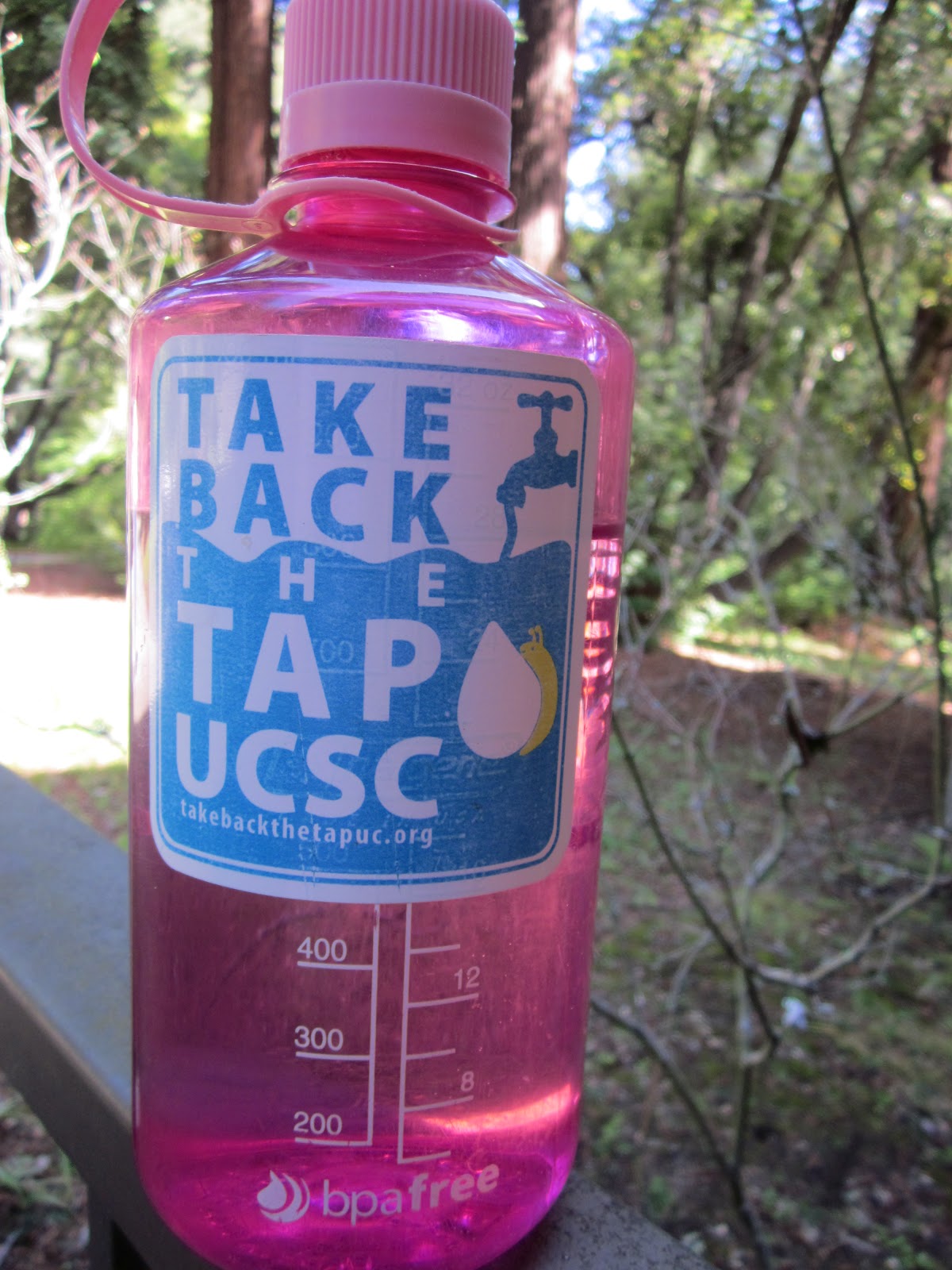
To find out more about UCSC efforts to get rid of plastic water bottles on campus and make it easier for everyone to fill up their reusable bottles, please check out Take Back the Tap UCSC!

Tuesday, May 15, 2012

June 2012: Innovative Approaches to Sustainability at Other Campuses

Here are a few selections of the innovative approaches to sustainability taking place on other college campuses. Each of these examples was chosen because it's something that UCSC could potentially implement in some way, or it's similar to something already being implemented on our campus. If you see something here that you want to make a reality at UCSC, contact the Sustainability Office and we will help you direct your ideas toward fruition!

Central Michigan U Launches 'Bring Your Own Bottle' Campaign
In effort to raise environmental awareness and sustainability through small steps, Central Michigan University’s Student Environmental Alliance has partnered with the Great Lakes Institute for Sustainable Systems to distribute 700 Bring Your Own Bottle (B.Y.O.B.) stickers around campus. Stickers have been placed near water fountains and trash cans to encourage the elimination of plastic water bottle waste. Find out about UCSC's own campaign for eliminating the use of single-use water bottles by checking out Take Back the Tap UCSC!

Unity College Steps Up Access to Clean Drinking Water
In answer to a campus student survey, Unity College has installed new water coolers in residence halls that use water from existing plumbing, and new fixtures on water fountains in public spaces that make filling water bottles easier, similar to the water spigots Take Back the Tap has installed around campus. To see more photos of the ones TBTT has installed at UCSC, click here.
Outside the Student Union Building, on the floor of the lounge.
Photo by Take Back the Tap UCSC.

UCSD student's Geared Up program helps find new homes for old atheletic gear
As a tennis player for the University of California at San Diego, Jacqueline Davis said that any college athlete knows that a ton of athletic gear they get often never gets used. Davis, who interned for the university's sustainability center, decided to tie athletics to the environment. She started the program she calls "Geared Up" which works to donate the athletic gear that might have otherwise been thrown away to public schools. The "Geared Up" program has already donated thousands of dollars' worth of equipment.

U Kansas, Utah Research Reveals that Nature Boosts Creativity
New research conducted by faculty from the University of Kansas and the University of Utah concludes that people from all walks of life show "startling" cognitive improvement — for instance, a 50 percent boost in creativity — after living for a few days steeped in nature. Without distractions of 21st century life including social media, electronics and cell phones, people have resources left over to be creative, imaginative and to problem solve. No wonder UCSC has such creative students, staff, and faculty--we are surrounded by forest everyday! Now, just turn off that cell phone, sign off of your computer, and get out there and enjoy the creative benefits of nature.
Near the Stevenson Knoll, overlooking OPERS and Monterey Bay.
Photo by Melissa Ott.

Santa Clara U Athletics Center Introduces User-Powered Treadmills
The university has added two new treadmills that are "powered by sweat" for a total of 33 fitness machines that are self-generating and require no electricity. In total, the university reports that the 33 machines save enough electricity to power a personal computer for 10 years.

U Louisville Students Install Recycled Solar Panels
Members of the university’s Renewable Energy and Efficiency Club are installing a small-scale solar energy project using recycled materials. Students purchased the solar cells from eBay and re-engineered the cell architecture to use a low-cost method. The panels will be used to power two fans that will ventilate a greenhouse.

St. Lawrence U to Launch Sustainability Semester
In spring 2013, student participants will be able to live and take courses together that address themes of human sustainability from a variety of disciplines. Located on a farm, the students will work on-site to grow food and build energy-efficient structures. The semester will also include an urban component where students spend two weeks in either Boston or New York to explore issues such as transportation, housing, food access, pollution and environmental justice.

Syracuse U Students Initiate Food Waste Audits
Two Sustainability Division interns recently gave their fellow students a firsthand look at the food being wasted in the campus dining center each day. Two dinnertime tray waste audits yielded a total of 278 pounds of tray waste, which was displayed for student viewing on a tarp-covered table in three separate piles: untouched food, food scraps and non-edible waste. The visual impact was designed to encourage students to waste less food.

U California Berkeley Debuts New Building Energy Dashboard
The university's new myPower site is connected to 57 campus buildings, allowing the campus community to view how much electricity a building is using in real time on their own computers. In addition to targeting individual behavior and behavioral change by showing how energy saving habits can make a difference, the new dashboard allows the university to spot and fix any energy-related issues. The university plans to get another 45 buildings online this year.

Cal State Monterey Bay Graduates to Wear Recycled Bottle Gowns
Every pound of yarn in the gowns that will be worn by this year's graduates at CSU Monterey Bay saves one-half gallon of gasoline and produces half of the carbon dioxide emissions of the typical polyester manufacturing process. These students really wear their environmental conscience on their sleeves--UCSC graduates should be able to, as well!