In 2015, Community Agroecology Network (CAN) began Growing Justice, a new initiative that focuses on urban gardens, food justice, and community well-being in Watsonville and Pajaro, California. Despite their location in the agriculturally-rich Pajaro Valley, food insecurity is on the rise. Food security refers to sufficient, safe and nutritious food that fulfills household dietary needs and preferences. Often, the very people who labor in the food system are unable to put enough healthy food on the table for their own families.
With support from the Everett Program at UC Santa Cruz, CAN and the Digital Nest in Watsonville, UCSC student, Sophia Bassett, conducted a three-day workshop that introduced students, from 8th grade to college, issues surrounding food access in Watsonville using digital mapping elements and tools through Google's My Maps. The students learned how to collect original data using GPS phone apps and surveys done on iPads. Next, they learned how to upload the data and visualize it. The students were also able to compare their data to existing census data to understand the power of visually presenting information. One student compared which was more accessible, fruit or fast food? Another compared the availability of produce and fast food restaurants with an overlay of median income ($32,000). A third compared vegetable quality and prices in nearby markets to mean household income ($39,378.) for a specific area in Watsonville. Learn more about this work and see the student maps.
Pages
Connect With Us!
Wednesday, November 18, 2015
Seed Saving Strategies in San Ramon, Nicaragua
Adriana Murguia completed a senior internship documenting forms of seed saving as her senior exit for the Environmental Studies Major and Agroecology Concentration. To support her work, Adriana applied to a series of campus grants, did community outreach, and fundraised her way to Nicaragua. Preparing for her fieldwork, she worked alongside CAN Associate Director Heather Putnam, and UC Santa Cruz Environmental Studies professor Stacy Philpott, collecting background information on household seed storage and collective seed banks and the most common causes of seed loss.
In July and August 2015, Adriana spent five weeks living in one rural coffee cooperative and traveling to seven others to collect information directly from farmers about their seed saving habits and challenges.
What Adriana learned was the trouble began even before the seeds were stored. The main cause of seed loss was grain weevils. Learn more about her research.
In July and August 2015, Adriana spent five weeks living in one rural coffee cooperative and traveling to seven others to collect information directly from farmers about their seed saving habits and challenges.
- Her research questions were:
- In what ways are farmers experiencing seed loss?
- What is being done?
- What are ways to improve or maintain seed quality?
What Adriana learned was the trouble began even before the seeds were stored. The main cause of seed loss was grain weevils. Learn more about her research.
Smart Bike Lockers
Transportation and Parking Services (TAPS) is pleased to announce that 12 additional, “smart” bike lockers have been installed at campus locations. Lockers are now available to all UCSC employees, students and visitors at seven locations on the main campus and the Marine Science campus: OPERS, Porter College, the Science Library, Engineering 2, Baskin Engineering, the Seymour Center and the Center for Ocean Health. These lockers are available first-come, first-served and provide on-demand, safe, secure, and covered bike parking that can be shared by multiple cyclists. All lockers are operated as part of the Bikelink network and a fee of $.05 per hour will be collected at the locker. For more information or to purchase a BikeLink card, please go to www.bikelink.org.
Tuesday, November 17, 2015
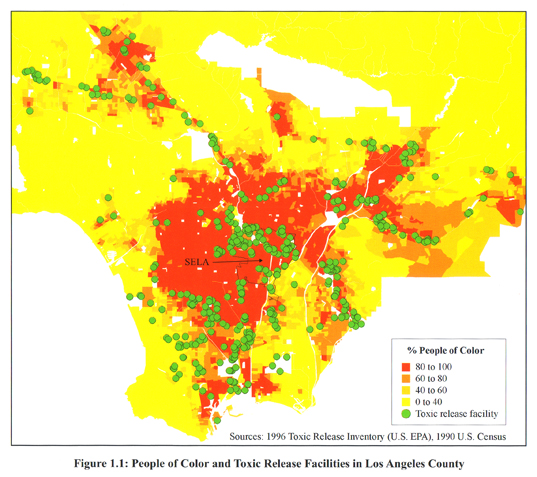
Systemic Oppression and the Natural World
Written by Jay Luce Nelson, UC Santa Cruz student and Chancellor's Undergraduate Intern for the Sustainability Office
Source: 1996 Toxic Release Inventory (U.S. EPA), 1990 U.S. Census.
To me, social sustainability is just as important as environmental sustainability. Where environmental sustainability seeks to take care of our nonhuman environment, social sustainability cares for cultures and communities. If the idea of sustainability as a whole is to preserve and improve future generations’ standard of living, how can we hope for a better future for all without addressing racism, ableism, cissexism, and other systems of oppressive power dynamics? For me, the ideal form of sustainability activism combines both human and nonhuman aspects and celebrates the achievements and contributions of marginalized groups while challenging societal systems of power and oppression.
Before I go on, I want to say that nothing I am saying here is new. This information is out there if you look, already discussed by people who know far more about sustainability than I do at a much more personal level, many of whom are people of color speaking out about their own experiences. The information might be scattered through short personal blog posts and comments on news reports, but it is out there.
There is plenty to say about sustainability as a whole—and even environmental sustainability specifically—that demands more attention than it currently receives. There is always a need to discuss the destructive roles of colonization, colonialism, racism, industrialization, and capitalism in our treatment of the land, particularly in the United States but in other previous colonies as well. (A particularly horrifying yet rarely discussed example is the millions of deaths resulting from Belgium’s demand for collection of rubber from rubber trees in the Congo, documented in Adam Hochschild’s book King Leopold’s Ghost.) There is a need to address ongoing environmental racism in urban planning. There is always a need to discuss native land practices, which have often been formed over time through long processes of learning about the unique traits of the land, and recognize that there are and always will be people following these practices.
These issues will not go away in time if they are not addressed. I encourage everyone to look into these and search for the opinions and experiences of the lives these issues have affected. Academia is credible, but it cannot overshadow individuals. I wish I had more resources than I actually do regarding these vital topics but, for me at least, the greatest resource has always been listening to others about their experiences. Much of what I know about sustainability I learned in high school from paying attention on microblogging platforms and social media. I know that there is always more for me to learn.
So keep listening to others. Keep learning. Do not let academia detach you from the emotions of those that sustainability initiatives affect. And most of all, keep thinking about the root causes of these issues and addressing the systems of power and oppression behind them.
Thursday, November 12, 2015
December Sustainability Profile: Catherine Alfaro and Amran Khan
Each month, our newsletter features a person or group on campus that is working toward a more sustainable world.
This month features American Indian Resource Center and People of Color Sustainability Collective interns Catherine Alfaro and Amran Khan. Catherine and Amran work together to showcase the historical, current, and future impact of people of color in the sustainability movement.
How would you describe the goals of the People of Color Sustainability Collective?
If you could send one message about sustainability to everyone at UCSC, what would you say?
Amran: You can be sustainable about anything that impacts you or your greater interests.
Catherine: What I would say to people is that it would be good to reflect a little about their own definition of sustainability, why they think that, and how they could link it to the work they do. Also, that we might want to rethink our strategies on how to sustain our earth, and that people from a multitude of backgrounds and disciplines need to get together and talk about what is going on. All the different perspectives are needed to create a more inclusive and sustainable campus.
This month features American Indian Resource Center and People of Color Sustainability Collective interns Catherine Alfaro and Amran Khan. Catherine and Amran work together to showcase the historical, current, and future impact of people of color in the sustainability movement.
What is your title, affiliation, and year?
Amran: American Indian Resource Center and People of Color Sustainability Collective intern; College 10 affiliated junior.
Catherine: Intern for the American Indian Resource Center and Student Coordinator for People of Color Sustainability Collective; College 10 affiliated senior.
What does “sustainability” mean to you?
Amran: Sustainability to me is more than just trying to preserve our environment, but also our culture, language, history, people, and future. There is no way of talking about sustainability without talking about issues like social justice and inequality. Sustainability involves everyone and everything from class, color, religion, et cetera. Being sustainable is important because it helps us to remember our roots and how we got to where we are.
Catherine: Sustainability to me means sustaining the balance of many parts of life. A great reference for me is the web of life which shows the interconnectedness of everyone and everything. Culture, community, health, education, animals, individuals, food, the living and non-living things, et cetera are all connected. We all affect each other in positive and negative ways, but learning how to sustain every aspect of life is important. By sustaining I mean learning about culture, community, education, animals, health, food, the living and non-living things and preserving these entities. One important thing that I have learned is that there are many ways to define and practice sustainability. There is not a one size fits all or guidelines to being sustainable. I would only think about ecology when people would mention sustainability. It took a long time for me to define sustainability in a holistic way.
How would you describe the goals of the People of Color Sustainability Collective?
Amran: The goal of People of Color Sustainability Collective is to educate and show UCSC students the contributions people of color have made and will make for environmental justice. We also want to create spaces for people to be able to share their knowledge and experiences in the environmental justice movement.
Catherine: I would say that our main goals are to bring awareness and highlight the work that People of Color are doing in regards to sustainability. Also, to create spaces where people of color feel comfortable to share their views, experiences, and outlooks on sustainability as well as to redefine sustainability to include a variety of interpretations.
Any projects you're looking forward to this year?
Amran: People of Color Sustainability Collective has a lot of exciting projects in the future ahead. I am excited for more discussion, events, and activities in the future and next quarter to come. Also in the winter quarter, People of Color Sustainability Collective will be conducting research at UCSC, based on environmental and social justice.
Catherine: I am excited for the research Amran, Adriana (the People of Color Sustainability Collective Coordinator), and I will be working on in regards to student opinions, experiences, and perceptions about inclusivity in the campus sustainability movements. Also, I am excited for the different collaborations and events that we will be working on throughout the year.
What made you interested in sustainability?
Amran: Growing up as a person of color, I became interested in sustainability when I realized how much people of color are impacted by environmental issues and how little people recognized this.
Catherine: Before joining the People of Color Sustainability Collective, I thought I did not know much about sustainability. I did not think I was sustainable myself. What changed my outlook on sustainability was re-defining what it meant to me. Both mentor Adriana Renteria and Dr. Rosser’s recommendation that I read the book by Enrique Salmon, Eating the Landscape: American Indian Stories of Food, Identity, and Resilience, helped me re-define sustainability. Learning that there are many components to sustainability and realizing that my family, my culture, and the work that I do are sustainable practices made me feel comfortable with the concept of sustainability. Realizing that all my life my family has been sustainable through actions that are seen as minuscule things like wearing hand-me-downs, re-using containers, trying our best to not waste food, and finding ingenious ways to work with what we have made me interested in sustainability. Validating the work that I have done within College 10 and the Ethnic Resource Centers that foster community, culture, and retention of students as something sustainable also made me interested. Being able to highlight the work that I do and redefine sustainability has been a big motivation.
If you could send one message about sustainability to everyone at UCSC, what would you say?
Amran: You can be sustainable about anything that impacts you or your greater interests.
Catherine: What I would say to people is that it would be good to reflect a little about their own definition of sustainability, why they think that, and how they could link it to the work they do. Also, that we might want to rethink our strategies on how to sustain our earth, and that people from a multitude of backgrounds and disciplines need to get together and talk about what is going on. All the different perspectives are needed to create a more inclusive and sustainable campus.
You can find the information and contact page for the People of Color Sustainability Collective here and check out the Facebook page here!
Sunday, November 1, 2015
The Arboretum is partnering with Allterra Solar
The Arboretum is partnering with Allterra Solar to increase awareness about the Arboretum and the benefits of switching to solar and the urgency for doing it now. Tax credits are going away in 2016 plus the price for selling energy back to PG&E is decreasing next year, but if you sign up for solar soon you will be locked in to the higher rate of return for 20 years! There's great information on the urgency and current incentives here.
Allterra Solar will give every eligible person (must own house) a gift family membership (worth $65) to everyone who signs up with the promo code of "ARBOR" by the end of the calendar year. If someone is already a member, they can regift it.
Additionally, for everyone who goes solar, Allterra will donate $500 to the Arboretum.
This is a great example of private/public partnership, great town/gown relations, and community support.
Allterra Solar will give every eligible person (must own house) a gift family membership (worth $65) to everyone who signs up with the promo code of "ARBOR" by the end of the calendar year. If someone is already a member, they can regift it.
Additionally, for everyone who goes solar, Allterra will donate $500 to the Arboretum.
This is a great example of private/public partnership, great town/gown relations, and community support.
Cool Campus Challenge update!
With week 5 kicking off for the Cool Campus Challenge, we’ve achieved a lot! Over 1,100 students, staff and faculty have signed up for a total of 2.3 million points earned. This adds up to 2.3 million pounds of CO2 saved from our pledged actions. It’s an awesome achievement, but we can do more. There are also plenty more PRIZES to be given out to people who sign up and more for top earners!However, despite all we’ve achieved, UCSC fell from 3rd to 5th place since last month. We can move back to the top, but we need YOU! Invite your friends, professors, and co-workers to sign up and pledge actions to earn more points!
Did you know you can earn points for taking the bus, riding your bike, or ride sharing to campus? These simple actions, and so much more, are easy ways to lower your carbon impact and earn some points for UCSC. So how can we win this challenge and prove UCSC cares the most about lowering our collective footprint? If you haven’t signed up yet, please do! If you have, then continue to log in and complete pledges. You can even make your own actions that are not on the list. You also get more points if you add pictures. If you’d like to help spread the word and get your foot in the door to the sustainability office, contact fellows Jordi Vasquez (jpvasque [at] ucsc [dot] edu) or Jamison Czarnecki (jczarnec [at] ucsc [dot] edu).
Remember, this is MORE than a friendly competition! This is a chance for UCSC to show that we collectively care and support these initiatives. Every point earned is a statement to our regents that we want more actions like carbon neutrality! Thank you for working hard at this. We have 5 weeks left to show the other UCs that we really are the Coolest Campus!
Subscribe to:
Posts (Atom)