Pages

Connect With Us!

Showing posts with label compost. Show all posts

Monday, October 24, 2016

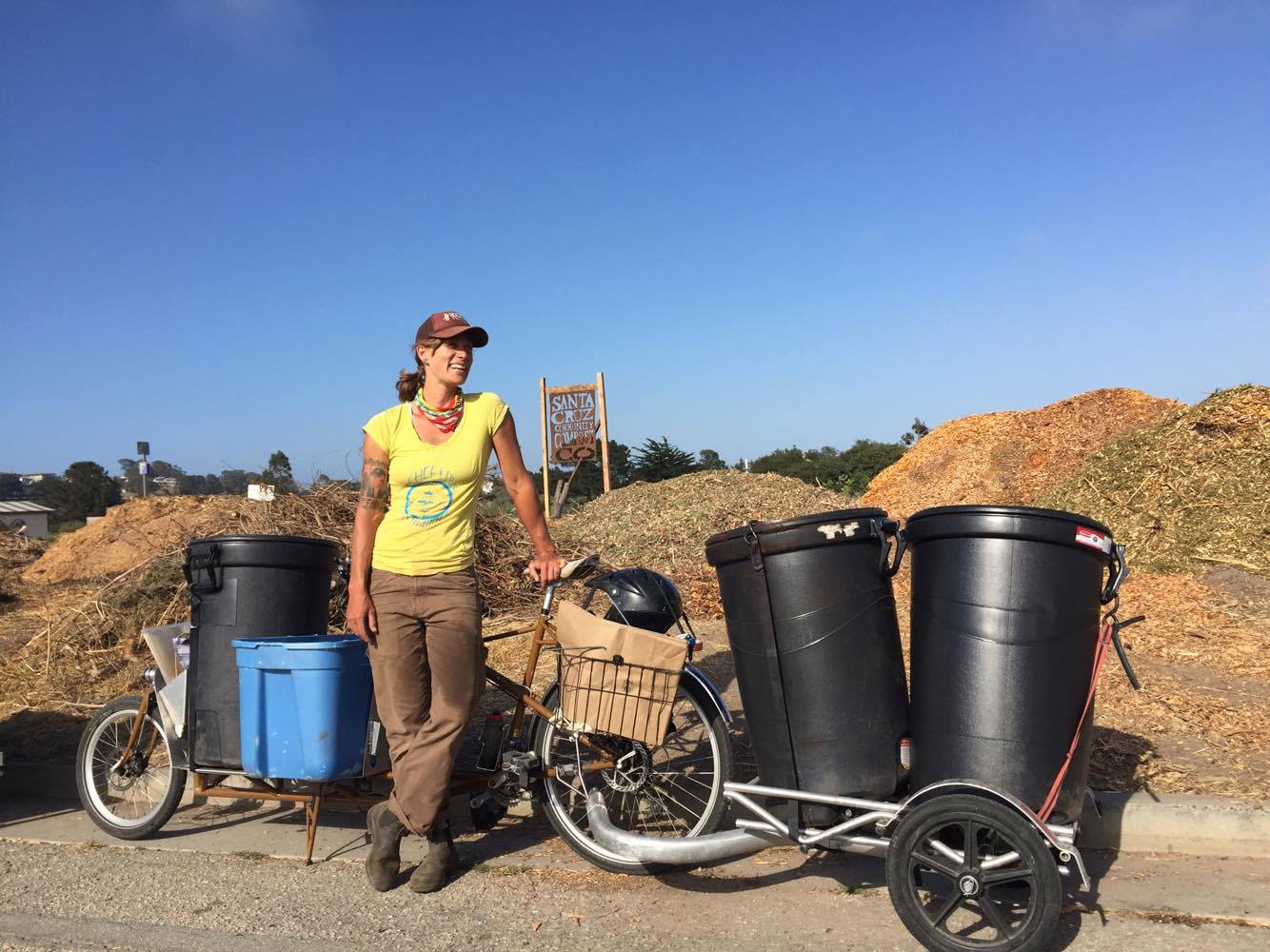
November 2016 Sustainability Profile: Ivy Young of Santa Cruz Community Compost Co.

Each month, our newsletter features a person or group that is working toward a more sustainable world. This month we are featuring Ivy Young of Santa Cruz Community Compost Co., which employs a number of UCSC alumni and turns Santa Cruz residents' food scraps into rich compost.

big haul.jpg
What does your organization do?
Santa Cruz Community Compost Co. is a bicycle-powered, community oriented, compost collection service. Customers collect their food scraps and other compostables in the bin we provide. Then, we pick it up weekly via cargo bike and deliver it to a local urban farm where we transform it into high quality fertile soil that is either returned to our customers or made available to the host farm.

How many pounds of food scraps does your organization divert from the landfill each year in creating compost? How many miles do your riders bike compost each year?
Since our first haul in June 2014 we have diverted more than 130,000 lbs of waste from the local landfill and we’re hauling around 2000 lbs more every week from around 250 local homes and businesses. Though we don’t track our riders’ miles, we cover ground from Shaffer at Delaware all the way to 42nd Ave and even take a trip up to the UCSC faculty housing once a week.  

How did you decide to use bicycles for transporting the compost?
The idea was originally sparked by a company in Austin, TX, the Compost Pedallers, that operates using a similar model. While bicycle transport does present some challenges, we believe in operating our business in a way that is energy efficient, inspiring and honors our core values. Bicycles are clean, quiet and when people see us out riding it puts a smile on their face.  

What’s one of your favorite memories associated with your organization and composting?  
I’m a single mom and in the first 6 months of operating routes, I often had my then 5 year old son riding on the back of my bike with me as I trekked all over town.  He would keep me company by singing “Keep on the Sunny Side” and he would chant “go mama, go mama, go” whenever I had to go up a hill.  I feel so grateful that he has been able to share in this experience and see what is possible when you work hard for something you believe in.

How did you get involved with composting?
I grew up composting so I’m someone who feels very strange whenever I’m faced with throwing a banana peel in the trash.  Most of my previous knowledge, however, was in the realm of small, backyard piles.  I have had to learn as I go about how to handle such large amounts of organic waste and I still have a lot more to learn.  I have become so excited now about the microbial universe living within a compost pile and the incredibly transformative process that occurs there that the work I’m doing is becoming a sort of philosophy to me.  

What does “sustainability” mean to you?
I don’t think that “sustainable” is just a catch phrase for the green movement.  To sustain something is to find the balance between what is possible and what is plausible. Sustainability is getting out on your tiptoes, reaching out for your most perfect Ideal, but not letting your feet leave the ground because you can’t inspire others when you’re floating in a bubble way out of reach, and it’s our collective efforts that will really make a difference. Sustainability to me is waking up each day, doing the very best you can and believing that your neighbor is doing the same.  

Has this job influenced you to live more sustainably in other ways?  
This work pushes me to my limits sometimes physically, socially and emotionally and while I had always considered my lifestyle to be sustainable because I eat organic, compost, and reuse my plastic bags and twistie ties at the bulk bins, I had never considered whether my inner life, social life or physical existence were truly sustainable. I’ve really tried in the last few years to apply the spirit of sustainable living to more than just how I consume things. Now, I ask myself questions like, “Am I an energy efficient vehicle?” “How does the energy I expend contribute positively to my community?” “Where is my time/energy/spirit being wasted and where is it being transformed into something useful?” I see the transformation that occurs in my piles--rotting detritus that smells somewhat like baby vomit becoming fresh living healthy soil that smells like the rain forest--and it gives me hope that even the most rotten things in life can, with time, be transformed into something beautiful.

Thank you, Ivy Young, for sharing about your work and inspiring us! To learn more about Santa Cruz Compost Co., visit their website.

Tuesday, October 27, 2015

November 2015 Green Tip: Have a Green Thanksgiving

Shop local and organic when it comes to groceries for Thanksgiving. This includes selecting a certified organic, pasture-raised turkey! Localharvest.org is an amazing resource to find places near you where food is grown and raised using sustainable practices! Also, avoid unnecessary food packaging by placing bulk-bin items such as rice or beans in your own reusable bags!

Avoid the use of beef in your Thanksgiving dishes. Not only does it require 1847 gallons of water per lb to produce, but also beef production releases five times the amount of greenhouse gas emissions as the average of other animal products and meats.

On Thanksgiving Day, carpool with friends or through zimride.com,  use public transportation, or ride your bike! Not only will this cut your overall gas consumption and carbon emissions, but you'll feel better about eating that last slice of pumpkin pie! During Thanksgiving dinner, remember to use cloth napkins, and if you don’t have enough dishes, go for the most eco-friendly option, like biodegradable plastic dishes!

Avoid wasting food by starting with small portions and taking as you need. If you’re hosting, ask your guests to bring their own Tupperware containers for leftovers to avoid using single plastics such as Ziploc bags or saran wrap. Start a composting bin and compost your food scraps!

Monday, October 5, 2015

October 2015 Green Tip: Reducing Halloween Waste

Pumpkin spice is quickly taking over the menus and shelves of the nation, the Halloween puns are beginning, and it’s time to start planning for the season. But instead of using plastic in your costumes and dumping rotting Jack-o’-lanterns in the garbage, here are some tips to keep waste out of the landfill!

Pumpkins are the perfect seasonal, edible, and compostable decoration! Instead of tossing pumpkin guts in the landfill this year, try some recipes such as pumpkin butter or classic roasted pumpkin seeds. Not interested in eating gourd guts or being stuck with a decaying Jack-o’-Lantern? Pumpkin is also easily compostable. Uncarved pumpkins can last for around 10 weeks depending on the variety, leaving plenty of time to enjoy your squash. Check out 50 pumpkin recipes to try this fall here!

Instead of buying a new costume and decorations, try making your own or buy one secondhand. If you’re up to the challenge, make a recycled costume out of cardboard, fabrics, or other materials you and your fellow costumers already have. Remind trick-or-treaters in your life to use reusable candy containers like canvas bags. Alternatively, have a decoration and costume swap with friends!

Reduce candy waste by choosing candies with relatively smaller amounts of wrapping. Opt for those in recyclable boxes instead of individually wrapped plastic when possible, and remember that you will always find someone else more than willing to eat any candy you may not want.

Remember to turn off and unplug electronic decorations when not in use, and have a safe and happy Halloween season!

Tuesday, October 21, 2014

November 2014 Green Tip: Sustainable Fall

Holiday season is creeping up quickly and here are some tips to make your holidays more sustainable!

Are you ready for Thanksgiving?

Invest in certified humane turkey, visit your local farmers market for organic cranberries, sweet potatoes and other fresh veggies.
While preparing your delicious meals collect food scraps before and after and start a compost at your home.

Do you know how you are getting home?  
Ride-sharing is a great way to get home without using a personal car, saving you money and reducing your pollution. Zimride is a website that posts rides for UCSC students, and all you have to do is pitch in for gas! If you have a car you can post your ride and Zimride can help you get people to pitch in for gas. It's a great way for travelers to reduce their carbon footprint. Zimride is available throughout the year so it can be helpful when going home for a weekend.

Are you trying to get to Los Angeles/Orange County? The UCSC Recreation Department is offering an LA Turkey Express bus for Thanksgiving that leaves Wednesday, November 26 at noon and returns Sunday, November, 30th. There is also an LA Polar Express that leaves on Thursday, December 18 at noon and returns Sunday, January 4.


Another great resource for heading up to San Jose (where there's a train station and airport that can take you elsewhere) is the 17 Express. This bus leaves from the local metro station in Santa Cruz. For only 5 dollars you can ride to San Jose.

Wednesday, May 21, 2014

Innovative Approaches to Sustainability at Other Campuses

Here are a few selections of the innovative approaches to sustainability taking place on other college campuses. Each of these examples was chosen because they represent ideas that UCSC could potentially implement in some form, or in some cases, already has begun to. If you see something here that you want to make a reality at UCSC, contact the Sustainability Office susted@ucsc.edu and we will help you direct your ideas toward fruition!

Composting Toilets Save Precious Water

Vermont Law School has composting toilets that use a biocompatible "foam flush" that use very little water and they have toilets that don't use any water at all. The waste goes into tanks in the basement where aerobic bacteria and earthworms convert the waste into potential fertilizer year-round. UCSC should implement composting toilets in a single building then the idea could spread across campus with every building having composting toilets.

St. Olaf College opens Ole Thrift Shop

The “shop" sells items that St. Olaf students donate as they move out of the residence halls. Rather than throw away or recycle the items, students place them in Ole Thrift Shop collection boxes throughout campus. Proceeds from the sales support other environmentally sustainable projects on their campus as well as several local organizations. With move out approaching UCSC, it would be great if we had a center that takes in old items.


Tuesday, April 22, 2014

Saving Water Every Day - Institutional-Scale Compost Toilets

Seminar date and time: Monday, May 19th, 12:15-1:40pm at the Kresge Seminar Room #159

Mention “composting toilet”, and most people will think of something suitable for a summer cabin or a rural residence off the grid---a kind of classy outhouse---surely not something suitable for installation in an urban environment. As one person has remarked, flush toilets are the accepted social standard. The idea of collecting human excrement in a basement composting bin does not exactly square with the modern paradigm of gracious living.

There is, however, more to the story. At this event, Peter Scott, a retired professor of physics a UC Santa Cruz, describes six composting toilet installations of varying types, currently installed for public use in locations in the United States, including three in California. He considers only those for institutional, industrial, municipal and commercial venues, i.e., those for which maintenance can be assured. In his descriptions, he includes comments by administrators, architects and users. As we shall see, every one of these six installations is positively viewed. He also includes answers to frequently asked questions, including discussions of costs and possible legal barriers.

This event is hosted by the Kresge Common Ground Center.

Wednesday, April 2, 2014

Innovative Approaches to Sustainability at Other Campuses

Here are a few selections of the innovative approaches to sustainability taking place on other college campuses. Each of these examples was chosen because they represent ideas that UCSC could potentially implement in some form, or in some cases, already has begun to. If you see something here that you want to make a reality at UCSC, contact the Sustainability Office susted@ucsc.edu and we will help you direct your ideas toward fruition!

New Compost Program, Targets Pizza Boxes

North Carolina State U Begins Pizza Box Composting. The university's Office of Waste Reduction and Recycling implemented the Pizza Box Composting Project, which seeks to decrease compostable waste on campus and encourage students to pay more attention to the importance of composting. These boxes, plus additional boxes from other campus organizations and personal purchases, will be turned into nutrient-rich soil through composting. So many students here on our campus order tons of pizza and it would be great if we had a pizza box composting system at UCSC too.

Stanford Farm Implements Water Conservation Techniques in Face of Drought

The Stanford Community Farm, a one-acre field located on the outskirts of campus, has implemented moisture-trapping gardening techniques in order to mitigate water usage, in response to the ongoing shortage of rainfall throughout California. They set up drip-watering systems that he estimated as being 80- to 90-percent more efficient due to plants having more time to absorb a more limited amount of water. The farm has also incorporated the use of three kinds of cover crops—oats, rye and bell beans—that have unique root systems conducive to allowing air and water to seep deeply into the soil. Without the cover crops, the soil would become compressed, which would eventually lead to erosion and a loss of valuable nutrients to wind and rain. If our CASFS isn't already using similar techniques, the farm should try this to conserve water.

U New Mexico Establishes Student Food Pantry

Imagine being a student who doesn't have enough money to buy healthy food. This is not as uncommon as many may think. If students don't eat properly, they cannot concentrate and do well in school. Recognizing that, the UNM Dean of Students Office, the Division of Student Affairs and a Food Bank are partnering to bring a mobile food bank to UNM students once a month. What would it take to have this at UCSC? This would be beneficial to students here.

Tuesday, February 18, 2014

Carbon Fund Receives Highest Number of Applicants Yet, Funds Over 20 Projects

The UC Santa Cruz Carbon Fund has had a successful and record-breaking funding round this year. In the fall quarter, the Carbon Fund Committee was pleased to receive a total of 40 project applications, the most the Committee has ever received in its four years of existence. The Carbon Fund, which is funded through student fee measure 44, is a valuable resource for students, staff, and faculty to receive funding for their projects that work to reduce greenhouse gas (GHG) emissions either on campus or in the Santa Cruz community.

This school year, the Carbon Fund has allocated over $200,000 in funds to over 20 new projects that work for reduce the carbon footprint both on campus and in the Santa Cruz community. Here are just three of the projects that received funding for the 2013-14 funding round:

Green Labs Certification Program
Allocated Funds: $1,500.00
The Green Labs Program strives to reduce energy use and waste from laboratories at UC Santa Cruz. They will be monitoring the energy use in labs and laboratory buildings that are part of their certification program in order to assess the efficacy of the energy conservation efforts they are encouraging. By monitoring, analyzing, and acting upon the electricity usage data gathered, they will be able to share actual energy consumption of the labs with personnel and improve their strategies for reducing energy consumption. Such efforts toward energy conservation will directly decrease the amounts of greenhouse gasses emitted at UC Santa Cruz.

UCSC Transit System Electric Vehicle Conversation Feasibility Study
Allocated Funds: $3,600.00
This project will conduct a feasibility study of a phased conversion of the current campus shuttle and vanpool system from gasoline and diesel to electric vehicles recharged by a campus solar PV system. Because the fleet vehicles must be replaced at the end of their useful lifetimes, an analysis of the costs, benefits and possibilities of purchasing smaller EV or hybrid vehicles--20 person vehicles and 6-8 person commuter vans--could show significant emission reductions. In combination with (a) a destination-demand system and (b) autonomous vehicles, the fuel use and operating costs of the system might also be significantly reduced. The present carbon footprint of UCSC's existing transportation shuttle system (buses and vans) is considerable. If properly designed and incentivized, a solar-powered EV shuttle and carpool system would offer an alternative to the current transportation fleet. The success of this new transit plan will cut down on independent car emissions as well as road congestion.

Compost Heated Water System

Allocated Funds: $5,000.00
The purpose of this project, taking place through the Center for Agroecology and Sustainable Food Systems at UCSC, is to investigate the possibility of energy production and waste mitigation through compost, as repurposing waste is crucial to fulfilling campus commitments to goals of zero waste by 2020. This project explores the possibility of composting woody biomass and other plant debris or “green-waste” in aerobic conditions at high heat, which is then used to heat water for cleaning and washing. The hot water produced by the composting process will reduce the campus carbon footprint by offsetting fuel or energy traditionally used to heat water. In addition to energy use reductions, this project will support other campus goals. The production of compost will improve the water-retention properties of soil, thereby reducing the demand for irrigation and helping the campus towards its goal of water-neutrality. The compost will be applied to PICA garden beds, increasing yield of the PICA garden beds by boosting soil fertility. This will help the campus achieve its 40 percent “Real Food” by 2020 goal.

To see a full list of the 2013-14 Carbon Fund Awards, visit project descriptions page on the Carbon Fund website.

Friday, October 18, 2013

November 2013 Green Tip: Sustainable Fall

The leaves are changing into those beautiful fall colors, morning runs are a little harder to get out of bed for, scarves and cozy sweaters are breaking out of the back of the closet. Fall is officially on its way, so to welcome it in Sustainability Office style, we've come up with some tips for the season:

1. Reusable mugs for seasonal drinks: Pumpkin spice lattes are pretty much the best tasting thing coffee culture has ever come up with, and during this season, they are everywhere! Keep your travel mug with you when you head to your favorite coffee shop to avoid generating waste with a paper cup, plastic lid, and cardboard sleeve. Forgot your mug? Many cafes have ceramic mugs "for here," so request one and enjoy the cafe. You could also ask for soy or almond milk for a treat that's animal product-free!


2. Compost those leftover Jack-O-Lanterns from Halloween!

3. Thrift for shop Fall clothing: There is nothing better than bundling up super warm when the weather turn cold, windy, or rainy. Gloves, scarves, hats, the whole shebang are perfect for fall. Instead of buying brand new fall wear, hit up one of the local thrift stores. There are so many funky, unique, cozy clothes. Why buy new things when you can reuse! Also, keep in mind that you are typically wearing sweaters outside of your other clothes, meaning you can wash them less often and reduce the number of laundry loads you need to make, saving energy and water.

4. Thanksgiving: Invest in a certified humane turkey, get veggies from the Farmers Market, and try and buy organic. This won't only taste better but it'll also be better for you.

5. Keep your head up. Sometimes when the weather starts to get gloomy, so do we. Put on your favorite fall tunes, bake a pumpkin pie, and smile to keep your personal sustainability going. The sun will always come out again!

Friday, May 24, 2013

Zero Waste Events: Student Perspective June 2013


As the year comes to an end the Zero Waste Team has been wrapping up some amazing pilot projects that got launched this year.  Along with the successful Bring Your Own Mug (BYOM) campaign, collaboration with PTAGS on paper towel removal from the dorms, collaboration on the creation of the position of Student Sustainability Advisors, and the Green Lab Certification Program, the Zero Waste Team has been working on the Zero Waste Commitment for student organizations on campus and a zero waste commencement 2013!

Zero Waste Event Commitment 
The goal for this pilot project is to increase the number of Zero Waste events on campus. Since a Zero Waste Event often requires more planning and support than a normal event, we hope to address this by providing training, materials, planning and volunteer support to help student groups make a commitment to Zero Waste. A Zero Waste Event (or a “Zee Wee” as nicknamed by Wikipedia) is an event that follows sustainable practices to send the least possible amount of waste to the landfill. This involves having a waste station to sort out trash, recyclables and compost. Check out the Sustainability Office  How to Hold a Zero Waste Event Guide  or the Plastic Free Blog  to learn more.

Milestones:
  1. Made a pitch and conducted brief trainings for Tri Chi Sorority, CARe Project, Chinese Student Association, Student Union Assembly
  2. Created an official logo to build a visual identity for the campaign
  3. Designed a Zero Waste Event Kit to be given out to orgs in the Fall
  4. Created a Trash Talkers’ pamphlet in collaboration with SEC

    Are you tired of waste at your events? Want your organization to be greener and help UCSC achieve Zero Waste by 2020? If interested in making the Commitment Pledge to make a future event zero waste, contact us now at zerowasteucsc@gmail.com  

Zero Waste Commencement 2013

The Zero Waste Team is working on making graduation at all ten colleges a zero waste event this year. Graduation is a wonderful opportunity to show the entire student community and the many visitors that our campus is committed to sustainability and our Zero Waste goal by 2020! We’ve partnered with Candy Berlin, Program Coordinator, UC Santa Cruz Dining, Zaunna Wells, Operations Manager, UC Santa Cruz Conference Services, Steve O'Neil, Bookstore, and Bob McCampbell, Executive Director Bay Tree Bookstore to make all ten college graduation ceremonies zero waste!

By providing waste stations for attendees to recycle and compost their waste, selling and giving away reusable water bottles at each ceremony with water refill stations, and promoting Zero Waste through signage and trained “Trash Talkers” to redirect recycling and compost from the landfill at the ceremony, we are truly committed to achieving our Zero Waste goal by 2020!

Tuesday, March 19, 2013

Tour of Physical Plant

On the morning of Thursday, February 28, the Student Environmental Center hosted a tour to UC Santa Cruz's Physical Plant, which provides services for the school in facilities & infrastructure operations, building maintenance, custodial services, grounds & road services, and refuse & recycling services. It was an opportunity for students to see what happens to campus waste and recycling behind-the-scenes.

Students and staff who attended the tour were first given a presentation about what streams of waste are sorted. The locations where waste is collected include the main campus, the marine campus at Younger Lagoon, as well as campus construction and demolition sites. The waste collected by Physical Plant includes cardboard, mixed paper, office paper, containers, compostable materials, metal scrap, construction and demolition diversions and organics (wood chips, grass, trimmings).

Student Environmental Center Waste Prevention Campaign Coordinator Darya Soofi and Intern Alexandra Corvello present about campus waste to students and staff who attended the tour of Physical Plant.

One thing that we learned during the tour was that 34% of residential waste from campus is from soiled paper, or used paper towels, alone. Stevenson College is the first college at UCSC to remove paper towels from the residential dorms in an effort to reduce this huge contributor to waste. Read more about the project at Stevenson here, and find out about how Cowell College is also making the switch here.

Food scraps and compostable items from the Dining Halls are trucked to a Marina composting site, but sometimes students take compostable containers from cafes on campus and dispose them in trash and recycling bins, where they are unable to be composted. If you take a container with you that says it's compostable, find a compost bin (cafes like Global Village Cafe and the Owl's Nest have them) to dispose it in.


Physical Plant also sorts recycling. UCSC receives money for recycling items by sorting out CRV (California Refund Value) containers from other recyclables and waste. This income helps fund operations and improvements to their recycling program.

Waste that cannot be diverted to recycling or compost is trucked to a landfill in the City of Santa Cruz called Dimeo Lane, where it costs $75 per ton to dump waste. A typical load of waste is 7-10 tons.

After the presentation, we were able to walk around the grounds and see all of the different types of trucks. The most exciting part was being able to see the conveyor belt that is used for sorting out all of the containers from the recycling.


How can you get involved with waste prevention?  Contact Elida Erickson about getting involved with the Zero Waste Team in the Sustainability Office or find out about the Waste Prevention Campaign at the Student Environmental Center by emailing Darya.

April 2013: Innovative Approaches to Sustainability at Other Campuses

Here are a few selections of the innovative approaches to sustainability taking place on other college campuses. Each of these examples was chosen because they represent ideas that UCSC could potentially implement in some form, or in some cases, already has begun to. If you see something here that you want to make a reality at UCSC, contact the Sustainability Office and we will help you direct your ideas toward fruition!

UC Davis Police hand out free bike lights
UC Davis are teaming to hand out bike lights - instead of citations - to students riding their bikes in the dark. Through this, they hope to educate students about bicycle safety law, and promote responsible cycling habits.

Wake Tech Community College Unveils Rooftop Solar Array
More than 1,300 solar panels have been installed on the roof of Wake Tech's Public Safety Education Campus, based in Raleigh, NC. Progress Energy will purchase the energy produced at a fixed price over the next 20 years as part of its SunSense program. The project is expected to generate more than $300,000 over the next two decades for student scholarships through the Wake Tech Foundation.

Knox College Theatre Students Promote Sustainability
Theatre students at Knox College (in Galesburg, IL) have raised an emphasis on reducing waste and promoting sustainability for its latest stage production. All items were reused from past shows, purchased from second hand/vintage shops, or created with the intention of being used again. The students also created a Sustainability Crew which included initiatives like sewing tote bags from old t-shirts, posting student videos promoting sustainability on YouTube, and encouraging others to be more sustainable in their everyday lives.

UC Berkeley Student Government Votes to Divest from Fossil Fuels
The Associated Students of the University California (ASUC) Senate has approved a bill ordering the divestment of its funds from fossil fuel companies while encouraging other institutions of higher education to follow suit. The bill binds the ASUC to complete the withdrawal of any of its $3 million in total investments from fossil fuel companies

University of Maryland Greek Community Launches Composting Initiative
Eleven Greek fraternities and sororities at the University of Maryland (College Park, MD) have launched composting initiatives since 2010. Compost collected from each participating house is taken to a compactor at one of the dining halls. The university has seen a significant increase in composting across the campus since the initiatives launched. In 2012, the university composted 566.18 tons, up from 138 tons in 2010.

Thursday, February 14, 2013

College 9 & 10 Recycling Campaign

The Waste Reduction Team at Colleges 9 and 10 is launching their "Don’t be Trashy, Recycle it Right!” campaign at Kresge College, Porter College, and Colleges 9 & 10. The campaign aims to raise awareness of recycling opportunities on campus and includes a map for each of these colleges that shows where to recycle or compost almost everything, including items such as electronics, food scraps, batteries, ink cartridges, and more.

The maps come with a handy key that describes the function of each type of recycle bin we have as well as having a picture of the bin so that people on campus can identify them. The maps will be up soon, so look for them if you’re in any of those four colleges.

Sustainable Living at PICA

by Lidia Tropeano

Food connects us all. The intricacies of its impact on the environment and people goes beyond the consumptive, especially when realizing the many layers of social, ecological and political needs to address. It can be overwhelming, but I have found resolution in how to face these challenges by living in PICA.


The Program in Community Agroecology evolves each year with a regenerative cycle of students participating in experiential learning. At PICA, students play a vital role in achieving a greater connection to their food system by sharing knowledge with the UCSC community with the support and guidance of staff at the Sustainable Living Center. The garden is a learning tool. Living at PICA has put my studies at UCSC into context, empowering me to attain greater environmental integrity. In a diverse group of students with varied personal backgrounds and major-interests, we live together, fostering pro-community sentiment with emphasis in food and environmentally-conscious life skills.


Through student facilitated garden work days, collaborative events with other campus organizations, garden market carts, academic courses, internships, and campus outreach and education, PICA has impacted over 4,000 students. What we do at PICA contributes to the larger vision of the UCSC Campus Sustainability Plan. Our compost system engages 150 Village residents, diverting their food waste from landfill and transforming it into soil. Individuals learn tangible gardening skills such as propagation, composting and planting from student leaders within the community, thereby expanding knowledge of agroecology, food systems and self-directed learning.


My peers’ commitment to achieving a more sustainable lifestyle is inspiring. PICA has granted me a sustainable future through these experiences in college where living in an intentional community has become a model for my life.

--

Have a perspective or story about sustainability at UCSC that you want to share on our blog and newsletter? Email Melissa Ott for details!

Sunday, November 25, 2012

Fall Waste Report and How You Can Help

The school year is off to a great start for waste reduction at UCSC! The Sustainability Office's Zero Waste Team has been working with campus partners and student organizations like the Student Environmental Center to help UCSC reach its commitment of being a zero-waste campus by 2020. Zero Waste is defined as having 95%-100% of all waste from campus diverted from the landfill through reducing the use of disposable materials and repairing, reusing, recycling or composting everything else.

Learn how the Zero Waste team has helped to make our zero-waste goal a reality at student move in, OPERS fall fest, and through a new reusable dishware program.

Fall 2012 Move-In
Each year freshmen and many returning students move into on-campus dorms and apartments, bringing with them thousands of pounds of waste. To insure that recyclable materials ended up in the right waste stream, the ZWT set up “cardboard corals” during move-in week at each college so students and parents could easily sort their waste into cardboard, Styrofoam blocks, Styrofoam peanuts, plastic film, and mixed recyclables. This year at move-in we collected:
  • 42,500 pounds of cardboard, the equivalent of 357 trees! 
  • 600 pounds of Styrofoam blocks that will be donated to a company that makes surfboard blanks (learn more about that company here)
  • 21,380 pounds of mixed recycles (aluminum cans, plastic/glass bottles, paper)
  • 300 pounds of plastic film; think about how light plastic film is, and how much must make up 300 pounds worth of it!
That's almost 65,000 pounds of recyclable material that was diverted from the landfill during move-in this year!


OPERS Fall Festival
Working with the recycling crew and OPERS staff, the ZWT set up and monitored four zero waste stations around this campus-wide event. Volunteers, or "trash-talkers," helped advise attendees about which bin their waste belonged in, helping keep our streams as pure as possible and educating students and festival-goers about what sustainability and zero waste looks like at UC Santa Cruz. We call this event "zero waste" because we greatly reduce the waste that goes to the landfill to a minimum. Making OPERS Fest zero waste is an ongoing process that also involves educating attendees about how to sort their own waste, and next year the campus will aim for even higher rates of "zero waste." 

For the first time, all waste was weighed and recorded, and these numbers will give the campus a starting point from which we can watch our waste reduce toward zero:
  • 1,755 pounds compost (that's about how much a typical giraffe weighs!)
  • 181.5 pounds recycling
  • 167.5 pounds cardboard recycling
  • 197.5 pounds trash

Slugware
Think about how much energy, water, time and money it takes to manufacture a disposable plate. To have it promptly disposed into the trash can after you eat from it for 10 minutes doesn’t seem very worth it. To change this, the Zero Waste Team piloted a project last year called “slugware,” an act of replacing disposable dishware with re-usable dishware at UCSC events. This would save tons of waste from entering the landfill and would also save the school plenty of money. As of now, the Ethnic Resource Center has slugware available for their events and College 8/Oakes and Crown/Merrill dining halls are participating in the washing of slugware. It is the goal for this year to expand slugware to other organizations and have the participation of all five dining halls. If we succeed, just imagine all the resources we're saving!

And here’s how you can help with campus waste reduction:

Food Recovery Challenge: Take only the food that you will eat in the dining halls, at campus vendors and events. Join us in our goal to reduce food waste by 5% by the end of this year and learn more about this goal here.

Compost: All dining halls and cafes run by dining compost your food scraps and to-go containers. Every month 50 tons of waste is diverted from the landfill from composting, so don’t forget to compost!

BYOM: Bring your own mug to campus!  Every year, students use tens of thousands of paper cups that go straight to the landfill.  Between 2010-2012 cafés on campus used 568,000 paper cups, 413,500 lids and 266,100 cup sleeves.  That’s a lot of trash! But we can change these figures:  If you bring your own mug to any coffee shop on campus you will receive a discount. The Perk Coffee Bars even have a Bring Your Own Mug Coffee Card that give you a FREE drink when you bring a mug seven times!

Reduce Paper Towel Waste: Check out information here about our pilot project with Path to a Greener Stevenson to eliminate paper towels in the restrooms at Stevenson College. Paper towels are a huge part of our waste stream and simple changes like eliminating paper towels from the residence halls can go a long way in reducing our waste!

Apply to be a Student Sustainability Advisor: Student Sustainability Advisors will be working with students, staff and the UCSC community to advise and educate students on sustainability. Plus you get $1500 towards housing each quarter! Check the UCSC Career Center Employment Request System for more info in the next few weeks.

Tuesday, November 20, 2012

Composting at the Colleges

Wondering how you can participate in reducing zero waste on campus in your living space?

Students in apartments can request a compost bucket, which they fill with cold composting food scraps and empty into bins near the recycling and landfill containers. Waste reduction teams empty the compost bins once a week and bring the food scraps to the garden. Go to fixit.ucsc.edu to request your compost bin right now!


Megan Taylor is a Waste Reduction Coordinator for Porter, Kresge, College 9, and College 10. Her job is to inform students about what to do with uncommon items that can be recycled like old electronics or batteries. "One main way that we’re helping to reduce waste on campus is through composting. I’ve been really excited with the amount of participation from residences so far."

Roughly 15% of all garbage at UCSC is food waste that could have been diverted from the landfill by composting (or by taking less food in the dining halls, at campus food vendors, and at campus events). Learn more here about our campus' commitment to reduce food waste by 5% this year by participating in the EPA's Food Recovery Challenge.

Monday, November 19, 2012

New Student Sustainability Advisor Positions in Colleges

For students living on campus, college life involves living, studying, and socializing in the college community they're affiliated with. In each of the housing areas, students produce waste and use resources in their day-to-day lives. At a campus where "environmental responsibility" is a part of our mission, UCSC colleges have created new Student Sustainability Advisor positions to support environmental responsibility on-the-ground.


"The SSA's primary role is to raise awareness and offer educational opportunities about ways campus residents can positively affect and contribute to UCSC’s sustainability goals," says Silas Snyder, Safety, Training and Conservation Coordinator for UCSC Housing and Dining Facilities.

Though many of the colleges are working toward zero waste goals, have gardens, or participate in composting, community life in the ten colleges at UCSC is about to get even greener, thanks to the new Student Sustainability Advisor (SSA) position that is currently open for applicants.

The SSAs will collaborate with campus sustainability leaders and residential life program staff and students to bring sustainability programs and awareness more to the forefront of residential life at UCSC. These student leaders will expand the team of people working on meeting the University's various conservation commitments, like the green house gas, landfill reduction, and water reduction goals. To learn more about the SSA position and find out how you can apply, please contact Silas Snyder or apply to ER #6782 the Employee Request System here.

Sunday, August 26, 2012

Green Tip #5: Reduce Landfill Waste through Composting

Anyone who's been in one of the UCSC dining halls in recent years knows that dining services composts the food waste that you leave on your plate. Some dining halls, like the one at Colleges 9 and 10, make you scrape your own plates into the compostable bags that are sent to a commercial composting center. Others scrape your plates for you, but all of that food waste ends up being converted into nutrient rich compost.
But did you know that students in the dorms and apartments on campus can also compost the food scraps left over from meals they eat in their own rooms? Instead of sending the food waste to a commercial composting center, however, the food waste generated in dorms and apartments can be collected and added to a cold composting system that is used in the many gardens on campus. For information about each college's system, where to drop off your food waste, and who to contact for more information, please check out this PDF created by the UCSC Zero Waste Team.

If you have further questions about composting on campus, please contact Silas Snyder.

For those of you who do not live on campus or frequent the campus dining halls, you can compost at home! Santa Cruz County has a food scrapping to compost progam, and you can find out more about it here.

You can, of course, also have your own cold composting bin in your own backyard! To get started, check out the EPA's guide to composting, and be sure to search the internet and local libraries for other guides. YouTube has many video tutorials for how to compost. Composting is great because not only does it reduce landfill waste, but it also creates free nutrient rich compost for your own backyard!

Zero Waste Orientations at UCSC

By focusing their efforts over the past five years, the UCSC Orientation Office has made significant progress towards making orientation programs zero-waste events. These efforts help introduce new UCSC students and family members to a culture of sustainability on the campus.

For example, all 7,000-8,000 participants receive reusable canvas bags with support from the Student Environmental Center to avoid using plastic bags, and students’ nametags double as reusable luggage tags. Also, four years ago they purchased colored flags to help new students navigate the campus, which eliminated the use of balloons. The reusable flags are much more functional and are loaned throughout the year to a least seven different offices on campus for various programs.


During all meals served during summer orientation, they have 6 to 7 zero-waste stations. Each station always has one to two Orientation Leaders present to help educate new students and families on how to best dispose of what was on their plates. During summer 2012 Orientation more than 3,000 pounds of waste were composted, compared to about 200 pounds of trash. 

Great work, UCSC Orientation Office and welcome to all of this year's new Banana Slugs!

Thursday, May 31, 2012

Early Educational Services: Teaching Eco-Responsibility to the Next Generation

Article by Grace Sorenson, Campus Sustainability Intern

From 11-month-old infants to pre-teens, the children in the Early Educational Services program at UC Santa Cruz are instilled with environmentally-conscious behaviors from day one.

“We are caretakers, but we are also preparing them to be responsible adults, and that includes behaviors such as recycling and composting,” says Sohyla Fathi, Director of Early Educational Services.

All food served at EES is prepared on campus. The menu is minimally processed and simple, and is organic or from the garden when possible. The kids eat together with their instructors, and green dishes for compost are located at each table. Reusable silverware and dishes are used at every meal. Each placemat at the tables is a laminated graphic delineating the basic food groups—grains, vegetables, fruits, protein, and dairy.

In the classroom where the youngest bracket of children are cared for, boys and girls between 11 months and 2 years old sit around a table with an instructor joyfully eating fruits and vegetables and cheese. A dish for compostable food scraps is on each table, and though they’re a bit too young to separate dairy products and vegetable matter, it seems that it’s never too early to start modeling the composting process. An instructor enthusiastically shows me a nearby poster with photographs of their regular field trip to the adjacent College Eight garden, where they empty their buckets into the garden’s compost.

In the sprawling outdoor play area there is a garden, and a nearby workstation with dwarf-sized gardening tools and a long line of miniature watering cans. There are tomato plants, parsley, cilantro, peas, basil, oregano, and mint. Sohlya explains that the kids plant the garden together and are each designated a specific plant that becomes their responsibility to care for and water. “That one’s mine!” a small blonde girl yells proudly, pointing emphatically at an oregano plant. When certain herbs or vegetables are used for a meal, the children harvest what is needed and bring it to the cook.


Clearly labeled, multi-lingual recycling stations are stationed in each classroom. Skylights illuminate most of the rooms with natural light, and containers and toys are made of wood and other natural materials instead of plastic. The lush forest surrounding the entire facility seems to serve as daily reminder to the kids of what the “environment” is and why it’s worth preserving. The values and habits imprinted upon us when we are young often last our entire lives, and it is an environment like this that will help foster a more responsible, ecologically-aware generation of young adults.