Pages

Connect With Us!

Showing posts with label course. Show all posts

Friday, September 21, 2012

IDEASS Sustainability Program Spaces Still Available - Apply Now!

Are you interested in...
  • Learning how to build and install a rainwater catchment system?
  • Sequestering energy for the grid from algae?
  • Creating a digital media platform to change Boardwalk consumer habits?
  • Installing an electric vehicle charging station on the Wharf?
  • Filming and editing a documentary about local sustainability initiatives?
  • Working with local businesses to reduce their carbon footprint?
Or maybe you have your own idea for a sustainable design project with potential to make a real community impact, but you aren’t sure how to make it a reality? If you answered yes to any of these questions and want to learn what it takes to work as a sustainability change agent, then you should apply to IDEASS!


Impact Designs: Engineering and Sustainability through Student Service is a new team-based internship program on campus designed to create opportunities for students to work on local (primarily off-campus) sustainability challenges with community partners or industry sponsors. 

Apply Now by Clicking Here! Applications to be considered for enrollment in Fall 2012 will be accepted until the program is full!

IDEASS offers a unique college experience. Students spend minimal time in the classroom, putting the majority of their effort into realizing project deliverables in the field. This is an opportunity for undergraduates approaching graduation to transition into the emerging green-technology workforce. Multiple IDEASS students graduating in 2012 are entertaining or have already accepted job offers resulting from their achievements working on an IDEASS project.
Santa Cruz Wharf Wind Turbine Project

Visit the Project Clearinghouse and search for IDEASS to view examples of completed and active IDEASS projects. Click here to read a student testimonial about an IDEASS project taking place in Porter College!

To find out more about IDEASS, please visit the website or contact IDEASS with any questions or concerns. IDEASS needs your talent, so apply today!

Tuesday, May 29, 2012

June 2012 Sustainability Profile: Stevenson RA Class & Sustainability in the Dorms

Article by Melissa Ott

If you ever lived in a college dorm, was sustainability a topic your residential advisor often brought up? Most likely not, unless you lived in a sustainability themed house or had a particularly environmentally minded RA. Fortunately, this is changing here at UCSC, and has been in the process of changing for some time. Already, there are signs in most dorm bathrooms reminding residents to turn off the sink when brushing their teeth or to take shorter showers. Stickers are great, but what about the conversations that need to go along with them? RAs present the ideal candidate for starting those conversations in the dorm communities to create lasting change in students' consciousness and behavior regarding sustainable issues.

We spoke with Stevenson RA Sarah Cohen earlier this quarter about the RA class that she’s teaching with two other RAs; one of the topics of the course is sustainability, and we were interested in learning more about the role sustainability is playing in RA training and dorm life. All students who will be RAs in Stevenson College next year are in this class, which discusses other topics such as health and wellness, diversity and social justice, leadership, and which works to create a bond among this team of leaders in the Stevenson community.

Sustainability is part of the curriculum for the course for a couple of reasons. One of the Stevenson dorm buildings, Casa Segunda (discussed in May’s profile, as well), is a sustainability themed dorm, so it makes sense to discuss what sustainability means among those who will be living in this house and interacting with those living in this house. The House 2 lounge is filled with magazines and other resources related to living a more sustainable lifestyle, and the RAs in this house this year are active members of Path to a Greener Stevenson (PTAGS), an environmental group that meets in this house’s lounge on Thursdays from 8-9 PM. While students with a particular inclination toward sustainability can choose to live in this house, it’s important that students in all of the dorms be exposed to the issues, practices, and reasons surrounding sustainability. Not to mention it is great to have these conversations going on in classes in which leaders are learning how to lead by example and talk with residents about important life topics.


“Students form habits early in college,” Cohen remarked. She said that it’s important to talk about sustainable habits with the RAs who will be there with incoming freshman at the beginning of their college career and who can help influence good decision-making. A student’s first year can be defining in what kinds of habits follow them throughout their lives. For many, it’s the first time they’re independent from their families and making decisions without their parents checking on them.

If you haven't seen The Story of Stuff, take 20 minutes and watch it right now (or at least send yourself a reminder to watch it after work or class). This short film was the homework assignment due the day that the RA class talked about sustainable topics. It’s a “a 20-minute animation” that focuses on “the consumerist society" and “the way we make, use and throw away Stuff” (1). Cohen said the discussion went well that day in class when these issues were brought up and that it was exciting to talk about these issues with RAs who will be able to continue these conversations with their residents next year. During the class, they spent some time "thinking about where all of the stuff in a freshman dorm would come from and how to help students think about those things during move in and move out," she described.

These conversations generated tangible ways for RAs to encourage sustainable behavior in their houses next year. Some examples were reminding residents to turn off lights, creating a box in the lounge to hold old fliers to be used as scratch paper, and posting reminders in the bathrooms about reducing water use.

The class also did an activity during which students became more aware of their own environmental impact and resource use in their everyday routines. "You wake up and use your alarm, which uses electricity," Cohen gave as an example. "You take a shower, which uses water and energy to warm the water... In the dining hall, where does that food come from? Your daily routine impacts the world around you."


What are some ways that students in the dorms can be more conscious of their impact and take steps to reduce it? Post your ideas in the comments!

Sarah Cohen previously worked with the Sustainability Office’s Green Office Certification program, and she is currently working on The Sustainability Awareness Promotional Video about campus sustainability to share with incoming freshman and the UCSC campus. She is a third year studying Global Information and Social Enterprise Studies (GISES), an Intensive BA Degree in Sociology.

--

Bibliography
1. The Story of Stuff website.

Tuesday, May 22, 2012

IDEASS Student Perspective: Porter Greenovation Project

By Nisa Taylor, IDEASS Intern

The IDEASS (Impact Designs: Engineering and Sustainability through Student Service) course has given many students, like my IDEASS project partner Sarah and me, the opportunity to pursue hands-on projects that promote sustainability through outreach and green energy retrofits.

Our project, the Porter Greenovation Project, has worked on retrofitting the Porter Study Center to make it more sustainable. We have performed energy efficiency measures and analysis, and we used this information to receive a grant from the Carbon Fund to retrofit the Porter Study Center to increase its efficiency and save money. With the help of the Carbon Fund Grant, we were able to install a new energy efficient lighting system that uses maximizes the use of natural light. It incorporates pull-down blinds, occupancy sensors to sense when people are in the room, and light dimmers.

To demonstrate to students how sustainable the study center can be when we use it with energy in mind, we plan to install lighting system information and waste diversion signage in collaboration with the UCSC's Zero Waste by 2020 campaign. Next year's annual Porter Fall Student Mural will be painted in the Porter Study Center with a sustainability theme to remind students about their healthy study space! Email Nisa if you want to learn more about getting involved with the project!

Please click here to find out more about IDEASS and apply today--the application deadline is June 20.

Tuesday, May 15, 2012

June 2012: Innovative Approaches to Sustainability at Other Campuses

Here are a few selections of the innovative approaches to sustainability taking place on other college campuses. Each of these examples was chosen because it's something that UCSC could potentially implement in some way, or it's similar to something already being implemented on our campus. If you see something here that you want to make a reality at UCSC, contact the Sustainability Office and we will help you direct your ideas toward fruition!

Central Michigan U Launches 'Bring Your Own Bottle' Campaign
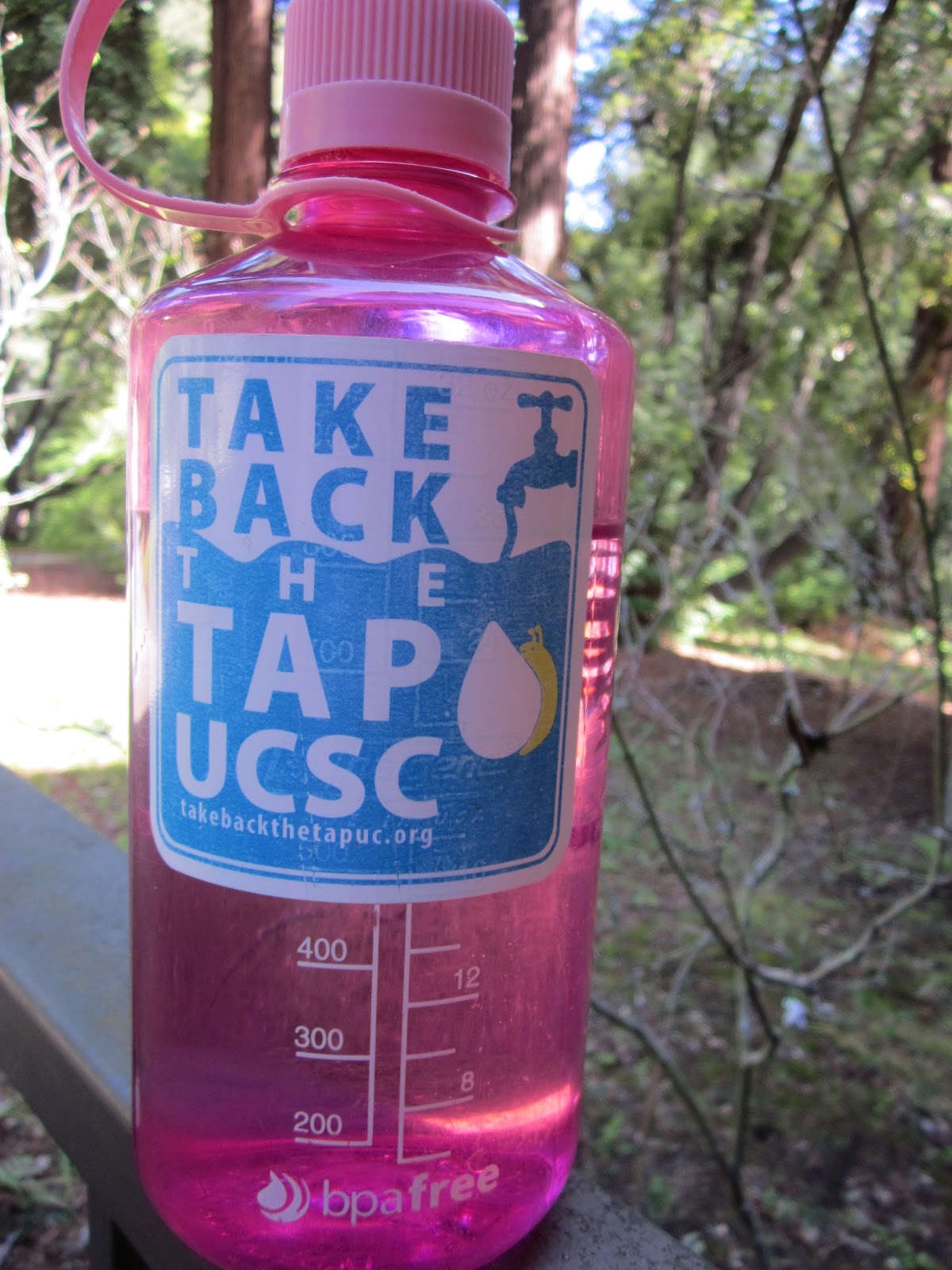
In effort to raise environmental awareness and sustainability through small steps, Central Michigan University’s Student Environmental Alliance has partnered with the Great Lakes Institute for Sustainable Systems to distribute 700 Bring Your Own Bottle (B.Y.O.B.) stickers around campus. Stickers have been placed near water fountains and trash cans to encourage the elimination of plastic water bottle waste. Find out about UCSC's own campaign for eliminating the use of single-use water bottles by checking out Take Back the Tap UCSC!

Unity College Steps Up Access to Clean Drinking Water
In answer to a campus student survey, Unity College has installed new water coolers in residence halls that use water from existing plumbing, and new fixtures on water fountains in public spaces that make filling water bottles easier, similar to the water spigots Take Back the Tap has installed around campus. To see more photos of the ones TBTT has installed at UCSC, click here.
Outside the Student Union Building, on the floor of the lounge.
Photo by Take Back the Tap UCSC.

UCSD student's Geared Up program helps find new homes for old atheletic gear
As a tennis player for the University of California at San Diego, Jacqueline Davis said that any college athlete knows that a ton of athletic gear they get often never gets used. Davis, who interned for the university's sustainability center, decided to tie athletics to the environment. She started the program she calls "Geared Up" which works to donate the athletic gear that might have otherwise been thrown away to public schools. The "Geared Up" program has already donated thousands of dollars' worth of equipment.

U Kansas, Utah Research Reveals that Nature Boosts Creativity
New research conducted by faculty from the University of Kansas and the University of Utah concludes that people from all walks of life show "startling" cognitive improvement — for instance, a 50 percent boost in creativity — after living for a few days steeped in nature. Without distractions of 21st century life including social media, electronics and cell phones, people have resources left over to be creative, imaginative and to problem solve. No wonder UCSC has such creative students, staff, and faculty--we are surrounded by forest everyday! Now, just turn off that cell phone, sign off of your computer, and get out there and enjoy the creative benefits of nature.
Near the Stevenson Knoll, overlooking OPERS and Monterey Bay.
Photo by Melissa Ott.

Santa Clara U Athletics Center Introduces User-Powered Treadmills
The university has added two new treadmills that are "powered by sweat" for a total of 33 fitness machines that are self-generating and require no electricity. In total, the university reports that the 33 machines save enough electricity to power a personal computer for 10 years.

U Louisville Students Install Recycled Solar Panels
Members of the university’s Renewable Energy and Efficiency Club are installing a small-scale solar energy project using recycled materials. Students purchased the solar cells from eBay and re-engineered the cell architecture to use a low-cost method. The panels will be used to power two fans that will ventilate a greenhouse.

St. Lawrence U to Launch Sustainability Semester
In spring 2013, student participants will be able to live and take courses together that address themes of human sustainability from a variety of disciplines. Located on a farm, the students will work on-site to grow food and build energy-efficient structures. The semester will also include an urban component where students spend two weeks in either Boston or New York to explore issues such as transportation, housing, food access, pollution and environmental justice.

Syracuse U Students Initiate Food Waste Audits
Two Sustainability Division interns recently gave their fellow students a firsthand look at the food being wasted in the campus dining center each day. Two dinnertime tray waste audits yielded a total of 278 pounds of tray waste, which was displayed for student viewing on a tarp-covered table in three separate piles: untouched food, food scraps and non-edible waste. The visual impact was designed to encourage students to waste less food.

U California Berkeley Debuts New Building Energy Dashboard
The university's new myPower site is connected to 57 campus buildings, allowing the campus community to view how much electricity a building is using in real time on their own computers. In addition to targeting individual behavior and behavioral change by showing how energy saving habits can make a difference, the new dashboard allows the university to spot and fix any energy-related issues. The university plans to get another 45 buildings online this year.

Cal State Monterey Bay Graduates to Wear Recycled Bottle Gowns
Every pound of yarn in the gowns that will be worn by this year's graduates at CSU Monterey Bay saves one-half gallon of gasoline and produces half of the carbon dioxide emissions of the typical polyester manufacturing process. These students really wear their environmental conscience on their sleeves--UCSC graduates should be able to, as well!

Monday, May 14, 2012

June 2012: Classes, Training & Community

IDEASS Now Accepting Applications: Deadline June 20
Are you an innovative, entrepreneurial, and self-motivated student seeking opportunities to put ideas about sustainable design, social change and environmental stewardship to the test? A new interdisciplinary program: Impact Designs, Engineering and Sustainability through Student Service (IDEASS) is now accepting applications for class enrollment for the 2012-2013 academic year. Juniors and Seniors from all majors are encouraged to apply. Click here for details, and here to apply now!

Opportunities with ESLP Next Year
The Education for Sustainable Living Program (ESLP) offered eleven wonderful student-led sections this Spring Quarter. They also had an inspiring guest lecture series that raised awareness and brought new ideas to the table about environmentalism and social justice issues. If you want to become part of the inspiration, they’re offering organizer positions and 2-5 unit internships for the upcoming academic year. For more information, visit their website or send them an email.

Summer Writing Workshops
This summer, UCSC Environmental Studies lecturer and research associate Sarah Rabkin will be offering a five-day writing retreat in the northern Sierra Nevada and two workshops at Sitka Center for Art & Ecology, on the Oregon coast. For more information, please click here.

Summer Institute on Sustainability and Energy: Apply by June 1
Graduate and senior-level undergraduate students are invited to apply for this University of Illinois at Chicago interdisciplinary program that explores a broad spectrum of sustainability and energy related topics including policy, economics, health, science, engineering, environment, urban planning, business and entrepreneurship. Themed "Election 2012: Energy, Economics and Environment," the August 2012 institute will use the presidential election as the point of departure for a critical analysis of national energy and sustainability issues. For fullest consideration, applications should be submitted by June 1.

Webinar: Creating a Bike-Friendly Campus Culture - June 6
Best for those institutions that are still in the foundational stages of developing a campus-wide alternative transportation strategy, this Academic Impressions webinar will take a step-by-step approach to creating a bike-friendly culture on any campus using Duke University (NC) as an example. Supported by AASHE, this event will start with basic initiatives including bike racks, bike storage rooms and bike maps, and move into deeper investments like developing effective town/gown relationships. It will take place at 4 PM online. Click here for more information and to register.

Wednesday, April 25, 2012

IDEASS Program Now Accepting Applications: Deadline Extended to June 20 - Apply Today!

Are you interested in...
  • Learning how to build and install a rainwater catchment system?
  • Sequestering energy for the grid from algae?
  • Creating a digital media platform to change Boardwalk consumer habits?
  • Installing an electric vehicle charging station on the Wharf?
  • Filming and editing a documentary about local sustainability initiatives?
  • Working with local businesses to reduce their carbon footprint?
Or maybe you have your own idea for a sustainable design project with potential to make a real community impact, but you aren’t sure how to make it a reality? If you answered yes to any of these questions and want to learn what it takes to work as a sustainability change agent, then you should apply to IDEASS!


Impact Designs: Engineering and Sustainability through Student Service is a new team-based internship program on campus designed to create opportunities for students to work on local (primarily off-campus) sustainability challenges with community partners or industry sponsors. 

Apply Now by Clicking Here! Applications to be considered for enrollment in Fall 2012 are due Wednesday, June 20!

IDEASS offers a unique college experience. Students spend minimal time in the classroom, putting the majority of their effort into realizing project deliverables in the field. This is an opportunity for undergraduates approaching graduation to transition into the emerging green-technology workforce. Multiple IDEASS students graduating in 2012 are entertaining or have already accepted job offers resulting from their achievements working on an IDEASS project.
Santa Cruz Wharf Wind Turbine Project

Visit the Project Clearinghouse and search for IDEASS to view examples of completed and active IDEASS projects. Click here to read a student testimonial about an IDEASS project taking place in Porter College!

To find out more about IDEASS, please visit the website or contact IDEASS with any questions or concerns. IDEASS needs your talent, so apply today!

Thursday, March 1, 2012

March 2012 Sustainability Profile: Campus Sustainability Internship Program

The Campus Sustainability Internship (CSI) program is a year-long course and internship designed to engage students in campus sustainability work. CSI provides students with trainings and resources to enable their success as future environmental professionals and leaders. The program pairs students with staff mentors to work on campus projects related to green building, waste reduction, energy conservation, and more.The application deadline is approaching quickly--staff applications are due March 16 and student applications are due April 4. Click here to apply now!

To give readers a first-hand account of the program, Student Newsletter Coordinator Melissa Ott interviewed two of the participants in the program to learn about their experiences in CSI. Kathryn Cunningham is a Strategic Sourcing and Sustainable Procurement Manager in Procurement and Business Contracts (P&BC) and CSI staff mentor to CSI Intern and Environmental Studies Senior, Christian Frederick (pictured below).

Melissa: What is the project that you’re working on, and why it's important for sustainability efforts and for the UCSC campus?

Christian: I am working with Procurement Department on creating a training program to education staff about “greenwashing,” which refers to false or misleading marketing claims aimed at promoting a product for its sustainability or environmental friendliness. By creating this training program, campus buyers can teach their on-campus clients how to identify environmentally preferable products more effectively and steer clear of marketing schemes geared toward misleading customers. This work will further campus sustainability by improving our green purchasing efforts and increasing the number of sustainable products at the university.

Kathryn: We want the program to use current products purchased by UC Santa Cruz personnel to explain and illustrate green washing tactics, and then offer alternatives that are better choices for the environment and society as a whole. Developing and delivering a green washing training program for P&BC will provide a better understanding of how marketing strategies can cloud good purchasing choices. With this understanding and the training program generated P&BC personnel can carry this to their campus clients. Once the campus clients—those making daily purchasing decisions—have the same knowledge, it is expected they will make more sustainable purchasing choices thereby improving UC Santa Cruz’s environmentally preferable purchasing metrics.

Melissa: Christian, the CSI program requires you to participate in class lectures and professional development trainings in addition to your internship work. Why has CSI been beneficial for you?

Christian: It allows me to take an active role in sustainable efforts within my (campus) community. I gained appreciation for sustainability through various classes here at UCSC but never truly felt I had any impact in matters until I started this program. This program has not only shown me how to take an active role in green purchasing but in all aspects of environmental awareness on campus. Through the class, we learn about institutional change and how students play a huge role as long as they participate. Through this class, and my work so far, I have become involved in multiple organizations on campus, including the Sustainability Office and the Green Purchasing Working Group. My involvement in these areas has provided me with an extraordinary level of experience developing professional skills in just the first half of the quarter. The experience has also helped me learn how to organize effective meetings, create project plans which help guide long-term work objectives, and polish my public speaking abilities. I receive this education both at the office with my staff mentor (by actually working in a professional environment) and in the classroom (through professional skills trainings and discussing ideas with my peers).

Melissa: Kate, what is useful about having student support for projects you are working on?

Kathryn: P&BC Buyers have been asking for this training for some time but our resources available for developing such a program have been limited. Now, through the Campus Sustainability Internship program we have that needed resource. This is Christian’s only project—we get fifteen hours each week focused on research, data analysis, supplier practices, and program development—it is going to be a great training program for buyers to share. Being located at 2300 Delaware, P&BC does not interact much with students so when we do have the opportunity, as with the CSI program, we get a sense of the energy on the hill.

Melissa: What made you want to participate in the CSI program?

Christian: I applied for the CSI program because I wanted to learn more about real-world efforts for sustainability outside of the classroom. I saw the internship as a great opportunity to take what I had been learning in the classroom and use it to make our campus more sustainable. I was also attracted to CSI because of it introduces student applicants to various staff and their projects on campus. Within the program, there is also overlap on projects, and I already have collaborations with about three other interns. This aspect is special to me because it resembles a real work environment. Each of us has a common goal for campus sustainability, but we are able to understand how cooperation from different areas is the key to making change.

Kathryn: The CSI program has given our department another format for communicating the work we do and the policies and procedures that govern that work. In addition to finally having a resource to put together a green washing training, we have used the CSI program as a chance to recruit for our Green Purchasing Working Group (GPWeG). While we have enjoyed some outstanding student members in the past, we’ve not attracted more than one at a time. Our last GPWeG meeting roster included five students. These student voices help us shape the work we do.

Melissa: What is the value of students and staff working together to foster a culture of sustainability at UCSC?

Christian: As a student it is easy to get caught up in the ideologies of change and sustainability without having the knowledge of how to act on them. Staff members provide the know-how and guidance required to make effective change on campus. Collaboration between the two groups is essential because it utilizes the drive and passion of students with the dedication and knowledge of staff members. We all want to make change for the better, and we all need to work together to make a difference.

Kathryn: Students have access to faculty and administrators in a very different way than most staff. When staff can share with students “how things work” at UC Santa Cruz, we all begin to make connections and form ideas that can lead to collaborative change in favor of sustainable business practices.

Want to talk to Christian and find out more about green purchasing? Interested in zero waste efforts? Be sure to attend the Zero Waste/Green Purchasing workshop this Saturday, March 3 at Earth Summit in the Colleges 9/10 multipurpose room from 12:45-1:45 PM. Learn how to reduce waste and green your campus with the power of purchasing, and if you’re interesting, speak with Christian about the CSI program. If you are interested in getting involved with the Campus Sustainability Internship Program as a staff mentor or as a student intern, find out more and apply here. Questions? Email Shauna Casey.